
Table of Contents
- What Makes a 72-Hour Survival Kit Essential for Your Family
- FEMA Emergency Kit Checklist: Core Supplies You Cannot Skip
- Emergency Food and Water Storage Requirements for 72 Hours
- DIY 72-Hour Emergency Kit List vs. Pre-Made Kits: Which Approach Works Best
- Customizing Your 72-Hour Survival Kit for Family Size and Climate
- Maintenance and Expiration Tracking: Keeping Your Kit Ready Year-Round
- Psychological Preparedness: The Mental Component of Survival Readiness
- Conclusion
Last Updated: August 6, 2026
What Makes a 72-Hour Survival Kit Essential for Your Family
When disaster strikes, you won't have time to think. A power outage, severe weather, or unexpected evacuation can happen without warning. A 72-hour survival kit becomes non-negotiable because the first 72 hours after any emergency determine whether your household stays safe, calm, and resourced.
At SHTF Prepper Club, we've helped thousands of families understand that emergency preparedness isn't about fear, it's about control. When you have the right supplies within arm's reach, you shift from victim to decision-maker. Your kids see you handling the situation. Your elderly relatives feel secure.
Emergency management agencies recommend that every household have supplies to sustain itself for at least 72 hours without external support. That's the minimum threshold before aid typically arrives. But a 72-hour kit isn't just about having stuff, it's about having the right stuff, organized in a way your family can actually use under stress.
Below, we'll show you exactly what belongs in a 72-hour survival kit, how to build one for your family's specific needs, and how to keep it ready year after year.
FEMA Emergency Kit Checklist: Core Supplies You Cannot Skip
The Federal Emergency Management Agency has established clear guidance on what constitutes a functional emergency kit. A FEMA emergency kit checklist includes water, food, first aid supplies, medications, documents, and tools for communication and safety. These are the result of decades of emergency response data showing what families actually need when systems fail.
Water comes first. You need one gallon per person per day for three days minimum. That's four gallons for a family of four. Store it in food-grade containers, rotate it every six months, and keep it in a cool, dark place. Buy sealed water pouches with five-year shelf lives and replace them annually.
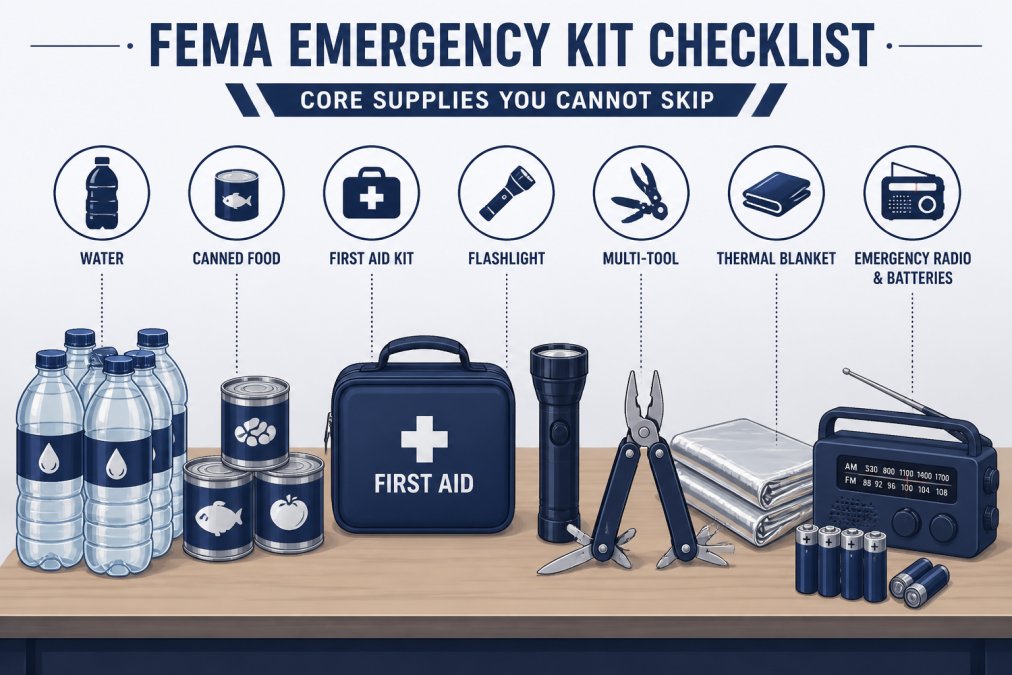
Food should be shelf-stable and require minimal preparation. High-calorie ration bars, canned goods with pull-top lids, peanut butter, crackers, and dried fruit work well. Include comfort foods your family actually enjoys eating, familiar food has psychological value beyond nutrition during a crisis.
A first aid kit is mandatory. Beyond basic bandages and antiseptic, include pain relievers, antacids, anti-diarrhea medication, antihistamines, and any prescription medications your family needs. Add a CPR mask if anyone is trained in CPR and a first aid manual.
Include a flashlight with extra batteries, a battery-powered or hand-crank radio, and an emergency whistle. These serve specific functions: visibility, information, and signaling for help. Avoid relying solely on your phone for light.
Add personal hygiene items: toothbrush, toothpaste, soap, feminine hygiene products, and moist towelettes. Include a sanitation kit with garbage bags, plastic ties, and disinfectant wipes to prevent disease and maintain dignity during stressful situations.
Store important documents in a waterproof container: insurance policies, deeds, medical records, and proof of residency. Include a list of emergency contacts written on paper and cash, ATMs won't work during power outages.
Emergency Food and Water Storage Requirements for 72 Hours
The baseline is one gallon of water per person per day. For a family of four, that's 12 gallons for three days. Many experts recommend two gallons per person per day to account for basic hygiene, bringing a family of four to 24 gallons for 72 hours. Store it in multiple containers so if one fails, you have backup.
Water purification is equally important. Sealed, commercially bottled water is safest, but water purification tablets, LifeStraw filters, or boiling capability provide backup options. Include at least two purification methods.
Food storage depends on your family's preferences and dietary restrictions. Calculate roughly 2,000 calories per person per day as a baseline. A family of four needs 24,000 calories over 72 hours. High-calorie, shelf-stable options include MREs (1,250 calories each), ration bars (400-600 calories), canned soups and beans, peanut butter and crackers, granola bars, and dried fruit.
Include foods your family will actually eat. If your family has allergies or dietary restrictions, plan accordingly. Store food in airtight containers away from temperature extremes. Rotate stock every 6-12 months, writing purchase dates on containers with a permanent marker.
DIY 72-Hour Emergency Kit List vs. Pre-Made Kits: Which Approach Works Best
A DIY 72-hour emergency kit list gives you full control over what goes inside, allowing customization for your family's specific needs. The DIY approach typically costs less if you buy strategically and avoid paying a markup for assembly.
However, DIY requires time, research, and follow-through. Many people start with good intentions and never finish, or assemble a kit and forget about it for years.
Pre-made kits solve the assembly problem. Companies like Uncharted Supply Co. and others have already researched and selected components that work together. The Uncharted Supply Co. SEVENTY2 Survival System costs around $599 and includes over 60 professional-grade tools selected by emergency responders and medical professionals. The American Red Cross Deluxe 3-Day / 72-Hour Emergency Preparedness Kit costs $184.00 and covers all FEMA basics. Stealth Angel Survival offers a 4-person 72-hour emergency survival kit for $179.29, which comes packed in two backpacks.
The trade-off is flexibility and cost. Pre-made kits aren't customized to your family and typically cost more per item. But they eliminate decision paralysis and ensure you have a complete, tested kit immediately.
A hybrid approach works well: buy a quality pre-made kit as your foundation, then customize it with your family's prescription medications, comfort foods, and personal items.
Customizing Your 72-Hour Survival Kit for Family Size and Climate
A kit designed for one person won't sustain a family of five. A kit assembled in Arizona won't address the needs of someone in Minnesota. Customizing your 72-hour survival kit for family size and climate is where generic advice breaks down.
Family size determines quantities. A single person needs one gallon of water per day. A family of four needs four. Families with elderly members or young children may need more because their bodies are more vulnerable to dehydration and temperature extremes. Calculate your household's exact numbers, then add 20 percent as a buffer.
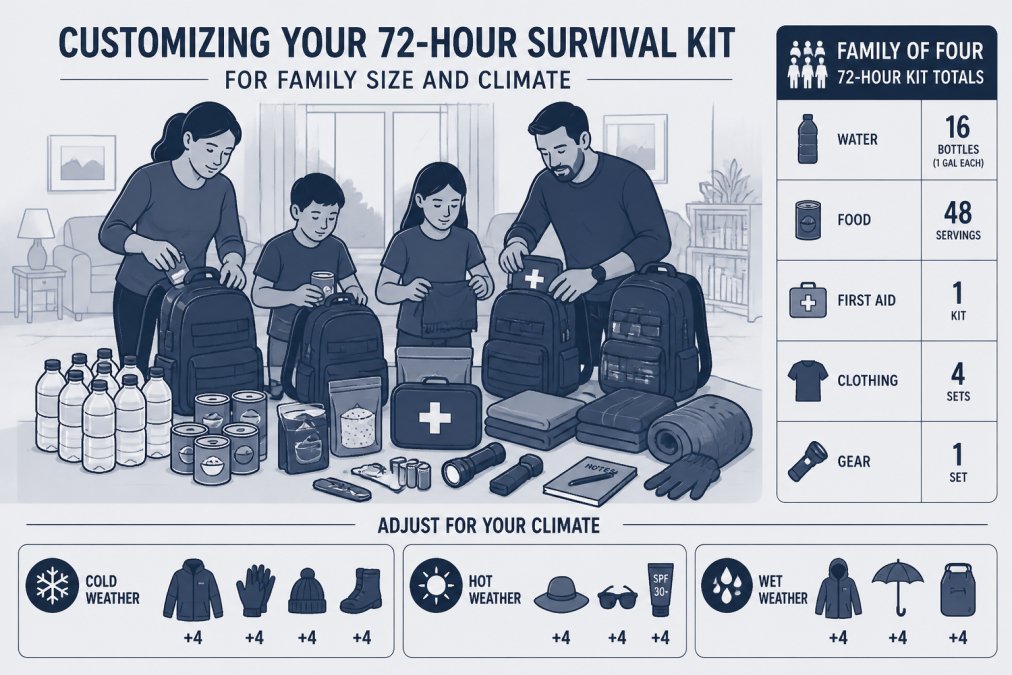
Climate determines what else you need. Cold climates require thermal blankets, warm clothing, hand warmers, and potentially a camping stove with fuel. Hot climates need increased water storage, electrolyte drinks, and lightweight, light-colored clothing that reflects heat. Humid climates require waterproof containers with desiccant packs. Earthquake-prone areas need tarps and duct tape. Flood zones need waterproof containers and elevated storage.
Tailor medications and medical supplies to your family's health needs. Include comfort items specific to your family, the psychological benefit during a crisis is real.
Maintenance and Expiration Tracking: Keeping Your Kit Ready Year-Round
Assembling a 72-hour kit is the easy part. Keeping it functional is where most people fail. Water doesn't expire, but batteries corrode. Food has shelf life dates. Medications lose potency.
Establish a rotation schedule. Every six months, review your entire kit. Check water containers for leaks or contamination and replace any that look cloudy or smell off. Test batteries and replace weak or corroded ones. Check food expiration dates and replace anything past its date. Check medications and replace any that are expired or discolored.
Create a simple spreadsheet listing everything in your kit with purchase dates and expiration dates. Store your kit in a cool, dry location like a basement or interior closet, not an attic or garage. Keep it accessible and label everything clearly with waterproof labels and permanent markers.
Consider storing backup kits in multiple locations: one at home, one in your car, and potentially one at work. Take photos of your assembled kit before sealing it and store photos digitally and in printed form for insurance purposes.
Psychological Preparedness: The Mental Component of Survival Readiness
Most survival guides ignore the mental and emotional component of actual emergencies. You can have the perfect kit, but if panic takes over, that kit becomes useless. Psychological preparedness is the difference between a family that adapts and one that falls apart.
Stress impairs decision-making. During an actual emergency, your prefrontal cortex shuts down and your amygdala takes over, triggering fight-or-flight responses. You can't think clearly or remember where supplies are stored.
Preparedness training reduces this response. Practice using your kit before you need it. Show your family where supplies are stored and walk through scenarios: "If the power goes out, we go to the basement where the kit is. We use the flashlight, check the water supply, and assess what we need."
Involve your children in preparedness. Let them help assemble the kit and practice using it. A child who has practiced with the flashlight feels less scared during an actual outage. Competence reduces fear.
Create a family communication plan with out-of-area contact numbers, a meeting point if separated, and decisions about picking up children from school. Practice staying calm under mild stress by intentionally losing power for an evening and using only your kit supplies. This shows you what actually works and builds confidence.
Accept that some things are outside your control. You can't prevent a hurricane, but you can prepare for it. This shift from "how do I prevent this" to "how do I handle this" is psychologically powerful.
Emergency preparedness isn't about fear or worst-case thinking. It's about removing uncertainty from your family's safety equation. When you have supplies, a plan, and confidence in your ability to handle disruption, you reclaim control during situations designed to create chaos.
SHTF Prepper Club simplifies this process by providing expert-vetted survival gear, comprehensive food storage solutions with up to 25-year shelf life, and reliable water purification systems. Start with a pre-made kit, customize it for your family's specific needs, establish a maintenance schedule, and practice using it. Your family's security depends not on hoping nothing goes wrong, but on knowing you're prepared when it does.
Frequently Asked Questions
What should be in a 72-hour survival kit according to FEMA?
FEMA recommends including water (1 gallon per person per day), non-perishable food, a first aid kit, flashlight with extra batteries, a battery- or hand-crank radio, medications, important documents, cash, and personal hygiene items. Your 72-hour survival kit should also contain a multi-tool, emergency whistle, and dust mask. Customize the kit based on your family's specific needs, including infant formula, pet food, or prescription medications that won't fit standard recommendations.
Is it better to buy a pre-made 72-hour survival kit or build your own?
Pre-made kits offer convenience and expert curation, ensuring you don't forget critical items. Building your own DIY 72-hour emergency kit list gives you control over quality and allows customization for your family's specific needs. Many households benefit from a hybrid approach: start with a quality pre-made kit and add personal items like medications, comfort foods, and family documents. The best choice depends on your budget, available time, and confidence in selecting individual items.
How often should I check and refresh my 72-hour survival kit?
Review your kit twice per year, checking expiration dates on food, water, and medications. Rotate expired items and update contents if your family size or health needs change. Test batteries and flashlights to ensure they work. Keep a maintenance log noting when items were last checked and what was replaced. This routine prevents surprises during an actual emergency and ensures your kit remains functional and ready when disaster strikes.
Do I need a separate 72-hour survival kit for each family member?
Yes, ideally each family member should have their own kit or a shared kit scaled appropriately for your household size. A single-person kit differs from a family kit in quantity and sometimes contents. For families, consider multiple smaller kits rather than one large one, so different people can carry supplies if evacuation is necessary. Children may need age-appropriate items, while elderly family members might need additional medications or comfort supplies in their kits.
This article was written using GrandRanker