
Last Updated: October 22, 2026
Quick Summary
To barter effectively during economic collapse, stockpile everyday consumables like rice, beans, and medicine before the crisis, then price goods by usefulness, scarcity, and shelf life using a written rate card. Negotiate with a written walk-away point and a fallback offer, and inspect every item before you swap.
- Keep your trade pile separate from your eating pile and store goods in small, single-use sizes.
- Price items by need, scarcity, shelf life, and divisibility rather than the sticker price you paid.
- Anchor slightly above your true target and justify it with scarcity, condition, or shelf life.
- Cap any single trade at under a quarter of your stock in one category.
- The fair market value of bartered goods and services is generally taxable income.
Table of Contents
- Step 1: Build Your Barter Stockpile Before the Crisis Hits
- Best Barter Items for Economic Collapse: What People Actually Trade For
- How to Value Items for Barter and Set Fair Exchange Rates
- Step 2: Negotiate the Trade Without Losing Your Shirt
- Real Barter Trade Examples You Can Model
- Bartering Safety Tips: Fraud, Disputes, and Meeting Strangers
- Legal, Tax, and Community Barter Networks to Know
- Frequently Asked Questions
Step 1: Build Your Barter Stockpile Before the Crisis Hits
Bartering is the direct exchange of goods or services without cash, and learning to barter effectively works best when you prepare before you need it.
A common mistake is buying only what your own household eats. Your trade pile should be separate from your eating pile.
- Set aside a small monthly budget for extra shelf-stable food
- Store goods in a cool, dry, dark space
- Rotate older stock into daily meals and replace it
The USDA food safety guidance on shelf-stable storage is a useful reference for safe storage basics.
Best Barter Items for Economic Collapse: What People Actually Trade For
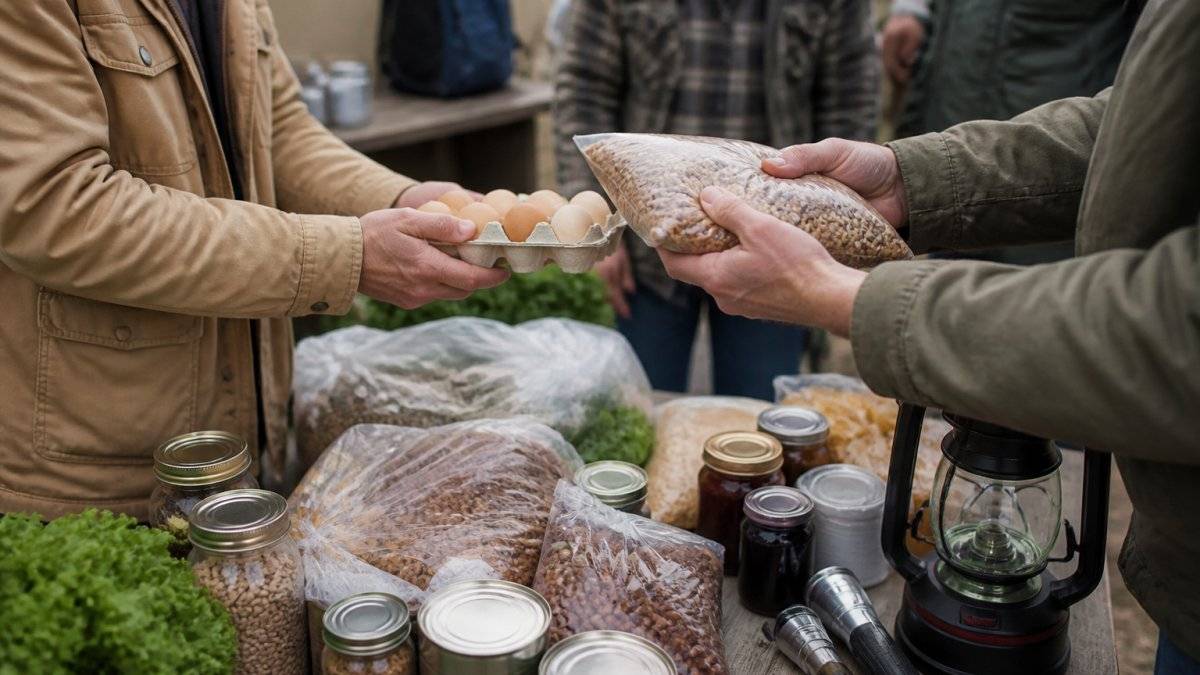
The best barter items for economic collapse are everyday consumables people cannot make at home. Think food, water, medicine, fuel, and hygiene supplies. In a real crisis, demand shifts fast toward survival basics.
Everyday consumables vs. long-term valuables
Consumables move quickly. Valuables hold worth but trade slowly. Most families need both.
| Category | Examples | Trade Speed | Best For |
|---|---|---|---|
| Everyday consumables | Rice, beans, cooking oil, soap, batteries | Fast | Daily needs, small trades |
| Medical supplies | Bandages, pain relievers, antiseptic | Fast | Families with kids or elders |
| Tools and fuel | Lighters, propane, duct tape, hand tools | Medium | Household repairs |
| Long-term valuables | Gold and silver coins, jewelry | Slow | Large trades, storing wealth |
Gold and silver hold value, but you cannot eat them. Keep precious metals for big trades and stock consumables for everyday swaps. The FTC consumer guidance on precious metals explains how metals are sold and what to watch for.
How to Value Items for Barter and Set Fair Exchange Rates
Valuing items for barter means pricing them by usefulness, scarcity, and shelf life, not by the sticker price you paid. A can of beans is worth more in week three of a blackout than it was on the store shelf. Here is a method you can run on paper tonight.
Step 1: Pick a unit of account
Choose one common, divisible item as your reference unit. Most families use one day of staple food for one adult, roughly a pound of rice or beans, or a comparable serving of shelf-stable food. Everything else gets priced against that unit. You are not creating money; you are creating a shared yardstick so two people can compare unlike goods.
Step 2: Score each item on four factors
For every item in your trade stock, rate it 1 to 5 on each factor:
- Need, how badly the average household needs it this week (water and medicine score high; jewelry scores low).
- Scarcity, how hard it is to get right now in your area. Check local supply before you set a rate.
- Shelf life and condition, sealed, dated, and storable beats opened, expired, or fragile.
Multiply or simply sum the scores to get a rough relative value. The exact math matters less than applying the same four factors to every item, every time.
Step 3: Build a simple rate card
Write your rates down and keep them with your inventory. A workable card looks like this:
| Item | Unit | Rate (in staple-food days) | Notes |
|---|---|---|---|
| Rice, sealed 1-lb bag | 1 bag | 1 | Reference unit |
| Canned beans | 1 can | 0.75 | Shorter shelf life once opened |
| Propane tank, full | 1 tank | 6-8 | High need in cold months |
| Pain reliever, sealed bottle | 1 bottle | 3-4 | High need, hard to substitute |
| AA batteries, 4-pack | 1 pack | 1.5 | Fast-moving trade good |
| Silver coin, 1 oz | 1 coin | 15-25 | Slow trade; large purchases only |
These numbers are illustrative, not fixed. Rebuild the card whenever local supply changes, after a storm, a store closure, or a supply disruption, scarcity scores move fast and your rates should move with them.
Step 4: Adjust for the situation, not the sticker
- Time matters. Food and fuel are worth more in the first weeks of a disruption; tools and skills gain value as repairs pile up.
- Condition matters. A sealed, dated item is worth more than an identical item with a broken seal, even if the contents are fine.
- Bundle size matters. Small, single-use packages trade faster and at a higher per-unit rate than bulk.
Step 5: Work a trade through the numbers
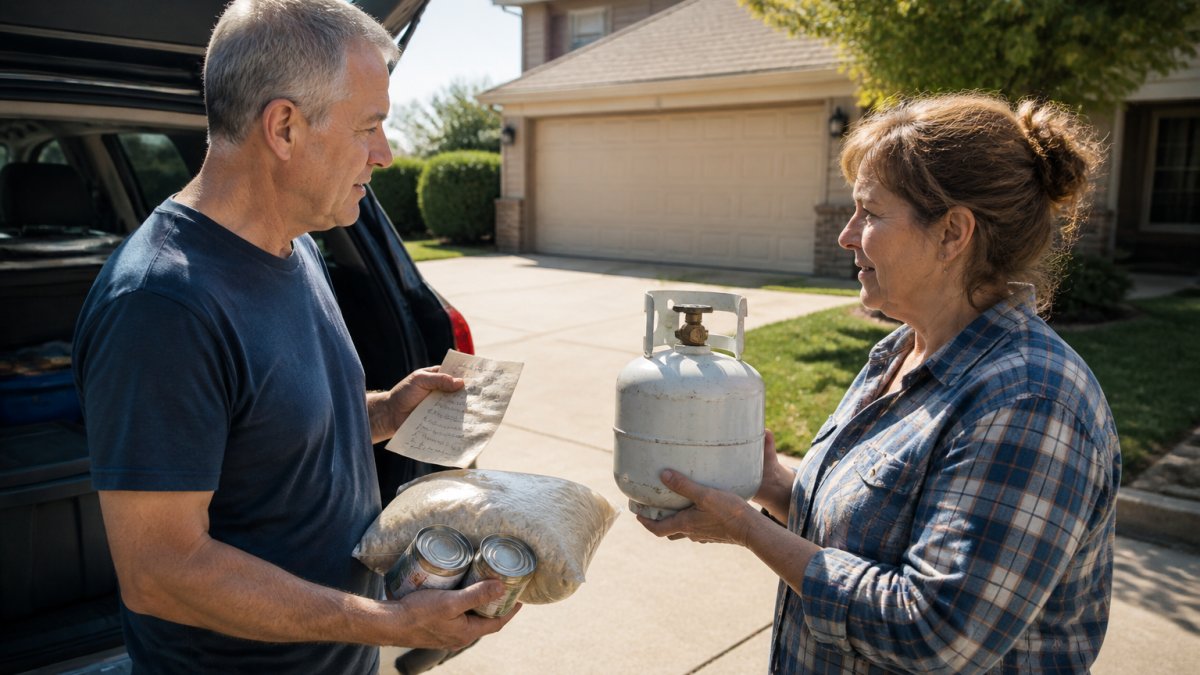
Suppose you want a full propane tank rated at 7 staple-food days. You have rice (1 per bag) and canned beans (0.75 per can). You offer four bags of rice (4) plus four cans of beans (3), total 7. That is an even trade on your card, and you can say so out loud: "Four rice and four beans comes to seven on my card, same as the tank." Naming the math makes the offer feel fair rather than arbitrary, and it gives the other person something concrete to counter.
A rate card turns barter from haggling into arithmetic. When both sides can see the math, trades close faster and relationships last longer.
Step 2: Negotiate the Trade Without Losing Your Shirt
Most barter guides stop at "be fair and stay calm." That is not a process. A trade is a small negotiation, and it goes better when you run it in a fixed order every time.
Before you leave the house
- Decide your walk-away point in writing. If you would not accept less than four cans of beans for a propane tank, write "4 cans minimum" on your list and do not negotiate past it in the moment.
- Bring a second item you are willing to part with. Having a fallback offer keeps you from overpaying when the first item is rejected.
- Bring a witness or a second adult if the trade is high-value, and tell someone where you are going and when you expect to be back.
Opening the trade
Open with information, not a price. Ask what the other person needs most right now, then describe what you have in plain terms: quantity, condition, and shelf life. For example: "I have six sealed one-pound bags of rice, stored cool and dry, best-by date next year.
This does two things. It lets them reveal their priorities, and it establishes that your goods are real and inspectable. Do not name a number yet.
Anchoring and the first offer
When you do name terms, anchor slightly above your true target and justify it with a concrete reason, scarcity, condition, or shelf life. "I was thinking four bags of rice for the tank, since the tank is full and rice is running short on my street." A justified anchor is easier to counter than a bare number.
If they counter, respond with a range, not a single number: "I could do three bags plus a pack of batteries." Ranges give the other side room to move without either of you losing face.
Conceding without losing ground
- Concede in small, decreasing steps. If you drop from four bags to three, your next drop should be smaller, not larger.
- Trade a concession for a concession. Never give something up for free: "I can do three bags if you throw in the spare mantles."
- Bundle, don't discount. If they want a lower price, add a small item to the deal instead of cutting your main ask.
Verifying before you hand anything over
Inspect every item in daylight before the swap. Open boxes, check seals, shake containers, test lighters and batteries, and confirm dates. If something is not as described, say so plainly and renegotiate, do not accept a damaged item to avoid awkwardness.
Closing the trade
Repeat the terms out loud before anything changes hands: "So that is three bags of rice and one pack of batteries for the full propane tank. Correct?" Get a verbal yes. For larger trades, write the terms on paper and have both people initial it. Then trade, thank them, and leave.
Keep the first trade with any new partner small. A successful small swap tells you more about how someone negotiates than an hour of conversation, and it gives you a reason to trade again.
A common mistake is negotiating in a crowd. Trade one-on-one when you can. Fewer eyes means less pressure, fewer competing offers, and less risk of someone following you home.
The best negotiators are not the toughest; they are the most prepared. A written walk-away point and a fallback offer do more for you than any clever line.
Real Barter Trade Examples You Can Model
Barter trade examples help you see how swaps work in practice. Here are three common patterns families use.
- Food for fuel: A bag of rice and two cans of beans for a small propane tank
- Labor for goods: Two hours of plumbing repair for a week of canned meals
- Skills for supplies: Haircuts or minor home repairs traded for batteries and soap
Skills and services as trade currency
Skills are often the most valuable thing you own. A nurse, mechanic, electrician, or carpenter can trade know-how for food and supplies. If you have a skill, list it now and practice it. If you do not, learn one basic trade like first aid or small engine repair.
Bartering Safety Tips: Fraud, Disputes, and Meeting Strangers
Bartering safety tips matter as much as the goods themselves. Fraud and disputes rise when cash is scarce and trust is thin.
- Meet in daylight in a public, familiar spot
- Bring a second adult and tell someone where you are going
- Inspect goods before you hand anything over
The best trade is one both sides would happily repeat. Fair dealing builds the network you will rely on later.
Legal, Tax, and Community Barter Networks to Know
Barter trades can carry tax and legal duties, so treat large swaps like business. The IRS guidance on bartering and taxable income explains that the fair market value of bartered goods and services is generally taxable income.
Community barter networks and local exchange systems help families trade fairly and safely. Look for neighborhood groups, church swaps, and local exchange clubs. These networks set ground rules, settle disputes, and build trust.
At SHTF Prepper Club, we help families build that foundation with vetted food storage, water filtration, power, and safety gear, plus step-by-step preparedness guides.
Frequently Asked Questions
What items are most useful for bartering during a crisis?
The items people trade for fastest are consumables with a long shelf life and obvious use: rice, beans, canned meat, coffee, sugar, salt, cooking oil, batteries, water filters, and over-the-counter medicine. Small denomination trade goods like lighters, soap, and sewing kits work well because they let people make change. Gold and silver coins hold value but are hard to break into small trades, so treat them as a store of value rather than your everyday barter currency.
How do you decide whether a barter is fair?
Anchor each item to a reference you both trust before you meet. That might be the last retail price you remember, a fuel-equivalent (how much propane or gasoline the item replaces), or a labor-hour standard. Then adjust for scarcity and need. A fair trade leaves both sides feeling they gained something, so build in a small margin rather than squeezing for the maximum. Write the agreed terms down and confirm them out loud before goods change hands.
How can you barter safely with people you do not know?
Meet in daylight at a public, visible location, bring a second adult, and tell someone where you are going and when you expect to return. Trade only what you can carry and never flash your full stockpile. Keep trades small and repeat with the same people once trust builds. For disputes, agree on a return window in advance and put it in writing, even if it is a photo of a handwritten note both parties sign.
How can you prepare for bartering before a crisis?
Start now by stockpiling a surplus of the barter items for economic collapse that store well, learning one practical skill neighbors will need (small engine repair, canning, basic first aid), and building relationships with nearby households. Practice small trades while cash still works so you learn how to value items for barter and how to negotiate without friction. A written inventory of what you have and what you would trade for keeps you from overpaying under pressure.
A real crisis tests more than your stockpile. It tests whether you prepared early, priced fairly, and traded with care. SHTF Prepper Club gives your household the vetted gear and clear guidance to stay ready, from long-term food storage to reliable water purification and safety tools. Get started with SHTF Prepper Club and build a trade-ready stockpile your family can count on.