
Table of Contents
- Why Play-Based Learning Beats Lectures for Disaster Readiness
- Emergency Kit Scavenger Hunt: A Hands-On Game for Building Your Supply Kit
- Emergency Preparedness Activities for Preschoolers: Simple Games for Ages 3-5
- Family Emergency Plan Template for Kids: Making the Plan a Game
- Disaster Supply Kit Checklist for Families: Turn Packing Into a Challenge
- Offline and Analog Games for When the Power Goes Out
- Post-Disaster Emotional Regulation Games for Kids
- Neurodivergent-Friendly Preparedness Games: Adapting Activities for Every Kid
- Frequently Asked Questions
Last Updated: September 14, 2026
Why Play-Based Learning Beats Lectures for Disaster Readiness
Emergency preparedness games for young kids work because children learn survival skills through repetition and play, not through warnings they can't process. A lecture about evacuation routes disappears by dinner. A game your child begs to replay sticks for years.
The American Red Cross guidance on teaching kids about emergencies makes the same point. Story-based and game-based learning gives children a sense of control instead of fear.
Below, we'll show you seven activities that build real disaster readiness, plus how to adapt each one for kids who need a different approach.
Emergency Kit Scavenger Hunt: A Hands-On Game for Building Your Supply Kit
The emergency kit scavenger hunt turns supply gathering into a race against the clock. Hand each child a printed list of items, set a timer, and let them hunt through the house for flashlights, batteries, and granola bars.
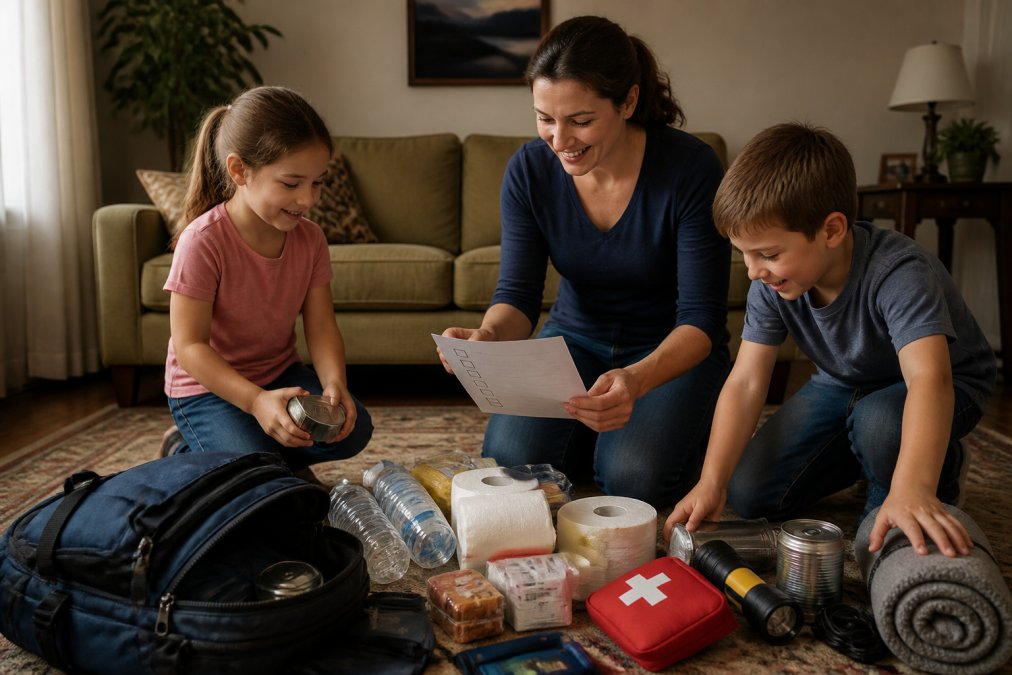
Here's how to run it:
- Print a checklist with pictures for non-readers
- Hide supplies around one or two rooms, not the whole house
- Set a 10-minute timer and cheer each find
- Review what's missing and add it to your kit together
A common mistake is turning this into a chore. Keep the energy up, and let kids "win" by finding the most items. The game ends with a functional emergency kit, which is the whole point.
Emergency Preparedness Activities for Preschoolers: Simple Games for Ages 3-5
Emergency preparedness activities for preschoolers need to be short, physical, and concrete. Kids this age can't grasp abstract risk, but they can practice a movement until it becomes automatic.
Stop, Drop, and Roll Relay
Line up the kids and call out "fire on your clothes!" Each child stops, drops, and rolls across a mat. Time each round and celebrate every attempt. Repeat until the sequence is muscle memory.
The Quiet Game: Practicing Calm During Alerts
Play a weather alert sound on your phone, then challenge kids to go silent and still for 30 seconds. This teaches the calm response you want during a real tornado warning or power outage.
Family Emergency Plan Template for Kids: Making the Plan a Game
A family emergency plan template for kids only works if children helped build it. Turn plan-making into a design project: let kids draw the meeting spots, pick the out-of-state contact, and decorate the printed plan.
Map Your Escape: Drawing Evacuation Routes Together
Give each child a blank floor plan of your home. Walk the house together and have them draw two exits from every room. Post the finished maps on the fridge.
The Ready.gov family communication plan guidance recommends keeping a wallet-sized contact card for each child. Let them decorate theirs, and the card becomes something they want to carry.
Disaster Supply Kit Checklist for Families: Turn Packing Into a Challenge
A disaster supply kit checklist for families becomes a game the moment you add teams, a timer, and a scoreboard. The goal isn't just a packed bin, it's a child who can name what's in it and why, because that knowledge is what they'll carry if the kit gets left behind.
Set up the game
Split the household into two teams. Assign each team a category. Set a 15-minute timer. The team that packs its category correctly and fastest wins, but the real scoring is a spot-check at the end: can each team name three items in the other team's bin and what they're for?
The checklist, with real quantities
Aim for a three-day supply per person for a go-bag, and a two-week supply for a stay-at-home kit. The table below covers the core categories; quantities are per person unless noted.
| Category | Items to Pack | Quantity | Who Packs It |
|---|---|---|---|
| Water | Bottled water, purification tablets | 1 gallon per person per day (3 days = 3 gallons) | Team A |
| Food | Shelf-stable meals, manual can opener, protein bars | 3 days of no-cook food per person | Team A |
| First aid | Bandages, antiseptic wipes, pain reliever, copies of medication list | One kit per household, plus a small kit per go-bag | Team B |
| Power & light | Flashlights, extra batteries, hand-crank or battery radio, phone battery bank | One flashlight per person, batteries sized to match | Team B |
| Documents | Copies of IDs, insurance cards, contact list | One set per adult go-bag, one set in the home kit | Team B |
| Comfort | Stuffed animal, small book, card deck | One per child | Team A |
Kid jobs that actually help
Young kids can't lift a case of water, but they can do real work:
- Ages 3-5: Hand items to an adult, put stickers on the bin, choose their own comfort item.
- Ages 6-8: Count batteries, check flashlight function, read the checklist aloud.
- Ages 9-12: Pack their own go-bag, test the radio, write the family contact card.
Giving a child a job they can complete is what turns packing from a chore into a game. A child who packed the batteries remembers where the batteries are.
The rotation rule most families skip
Food and batteries expire. Once a year, pick a date you'll remember, like the start of daylight saving time, pull everything out, check dates, and replace what's expired. Make it a game: lay every item on the floor and have kids sort into "keep" and "replace" piles. It takes 20 minutes and it's the difference between a kit that works and a bin of expired granola bars.
SHTF Prepper Club offers curated kits with food storage designed for long shelf life and minimal prep. If you'd rather skip the assembly step, our kits cover essential categories in one box, but run the packing game with your kids anyway. The bin is replaceable; the knowledge isn't.
Offline and Analog Games for When the Power Goes Out
Most preparedness content points parents to online simulation games and interactive quizzes. That advice fails at the exact moment it's needed most: when the power is out, the Wi-Fi is down, and the tablet is a dead rectangle. Screen-free games are the only preparedness tool that still works during a blackout, and they double as practice for the boredom and anxiety that follow a real disruption.
Keep a dedicated outage bin, a lidded plastic tote stored with your emergency kit, that only comes out when the power goes. Novelty is the whole mechanism here. A deck of cards your child sees every day is boring; the same deck pulled from a sealed bin in the dark feels like an event.
What to put in the bin
- Two decks of playing cards
- A set of dice and a scorepad
- A flashlight per child (so no one fights over one beam)
- Glow sticks
- A printed list of the games below, laminated so it survives spills
Games that build readiness skills, not just distraction
Flashlight tag. One child is "it" and sweeps a beam across the room; anyone caught in the light freezes. Works in any dark room and burns off the nervous energy that builds when kids are stuck inside. Best for ages 4 and up.
The memory map. One person names a room in the house, and the next person has to name two ways out of it. Go around the circle. This is the family escape plan disguised as a parlor game, and it surfaces gaps in your plan you didn't know you had, if your child can't name a second exit from the bathroom, that's a real finding, not a wrong answer.
Story rounds. Each person adds one sentence to a survival story. Start with a mundane problem ("the lights went out during dinner") and let the hero, always a kid, solve it with something in the house. This is the same mechanism therapists use to help children rehearse coping, and it costs nothing.
Candle-free shadow puppets. A flashlight against a blank wall plus hands. Younger kids (2-4) can't follow rules yet, but they can watch and copy, which keeps them calm and occupied while adults handle the actual emergency.
Twenty questions: emergency edition. One person thinks of an item from the emergency kit; everyone else asks yes-or-no questions to guess it. Reinforces what's actually in the kit without a single flashcard.
The rule that makes it work
Don't introduce these games for the first time during an outage. Play one or two on an ordinary weekend so the rules are already known when the lights go out. A game a child has to learn in the dark, while scared, is just another source of stress.
The CDC guidance on coping during emergencies notes that familiar routines and activities help children manage stress during disruptions. A card game they already know how to play does more for a frightened kid than any lecture about staying calm, and unlike a screen, it works when the battery is dead.
Post-Disaster Emotional Regulation Games for Kids
Post-disaster emotional regulation games give children a way to process fear without naming it directly. After a storm or extended outage, kids often can't articulate what scared them.
Try these:
- Feelings charades: Act out an emotion, and others guess it
- The brave story: Have your child tell a story where the hero (them) handled something hard
- Breathing buddies: Lie down with a stuffed animal on the belly and watch it rise and fall
These games work because they let kids externalize fear through play, which is how children have processed difficult events for generations.
Neurodivergent-Friendly Preparedness Games: Adapting Activities for Every Kid
Neurodivergent-friendly preparedness games adjust the format, not the goal. Kids with autism, ADHD, or sensory processing differences often need predictability, shorter sessions, and clear visual supports.
What works:
- Visual schedules: Picture cards showing each step of a drill
- Shorter rounds: Five minutes of practice beats a 20-minute session
- Advance warning: Announce drills ahead of time instead of surprising kids
- Sensory-friendly gear: Let kids pick their own flashlight or comfort item for the kit
The goal stays the same: a child who knows what to do. The path there just looks different, and that's fine.
Every family faces the same hard truth: the emergency will not wait until your kids are old enough to understand it. The good news is that readiness can be built through play, one game at a time.
SHTF Prepper Club makes the next step simple with expert-vetted food, water, power, and safety gear, long-term food storage built for up to 25-year shelf life, and preparedness guides. Get started with SHTF Prepper Club and turn family readiness into something your kids actually look forward to.
Frequently Asked Questions
What are some emergency preparedness activities for kids?
Emergency preparedness activities for kids include hands-on games like an emergency kit scavenger hunt, where children find and pack supplies around the house. You can also practice evacuation routes by drawing a map together, play the quiet game to rehearse staying calm during alerts, and use story-based learning with characters like Prepare with Pedro. These activities build disaster readiness without causing fear.
How can I make disaster drills less scary for young children?
Frame drills as games rather than warnings. Use a timer and turn evacuation practice into a race to see how quickly everyone reaches the meeting spot. Praise effort instead of focusing on mistakes. Keep your tone calm and reassuring. After the drill, talk about what went well and let your child ask questions. This approach builds safety literacy while reducing anxiety around emergency procedures.
What items should be in a child's emergency go-bag?
A child's go-bag should include a change of clothes, a small flashlight, non-perishable snacks, a water bottle, a comfort item like a stuffed animal, any needed medications, a family photo, and a written emergency contact list. Let your child help pack it so they know what is inside. Review the bag every six months to replace expired items and update clothing sizes.
What are the 5 P's of emergency preparedness for families?
The 5 P's are people, pets, prescriptions, papers, and pictures. People covers your family communication plan and meeting spots. Pets includes carriers, food, and leashes. Prescriptions means medications and medical supplies. Papers covers IDs, insurance, and important documents. Pictures refers to irreplaceable photos. Turn each category into a family challenge to make planning interactive and memorable for young kids.