
Table of Contents
- Why Apartment Emergency Preparedness Is Different
- Your Apartment Emergency Kit Checklist
- Emergency Power for Apartments: What Actually Works
- High-Rise Building Evacuation Plan: Stairwells, Routes, and Timing
- Apartment-Specific Fire Safety and Shelter-in-Place
- Family Communication and Digital Preparedness
- Pet-Specific Apartment Evacuation
- Conclusion: Start With One Closet
- Frequently Asked Questions
Last Updated: October 1, 2026
Why Apartment Emergency Preparedness Is Different
Emergency preparedness for apartment dwellers starts with one uncomfortable fact: you do not control the building. You cannot reinforce a wall, install a generator, or widen a stairwell. What you can control is what sits in your closet, what lives on your phone, and what your household knows to do when the power dies at 2 a.m.
Vertical Living Changes the Rules
Height, shared walls, and single points of exit define apartment emergencies. A house fire gives you doors and windows. A 14th-floor fire gives you one stairwell and whatever is in your go-bag.
Your Apartment Emergency Kit Checklist
A complete apartment emergency kit checklist fits in one closet and covers water, food, first aid, light, and documents. The apartment-specific constraint is weight and volume: everything you carry must fit a stairwell descent, and everything you store must fit a rental lease's limits on fuel, propane, and open flame.
Go-Bag (Carry-Down Tier)
Target 20-25 pounds for a single adult. A loaded bag that is too heavy to carry down 15 flights is a liability, not a plan.
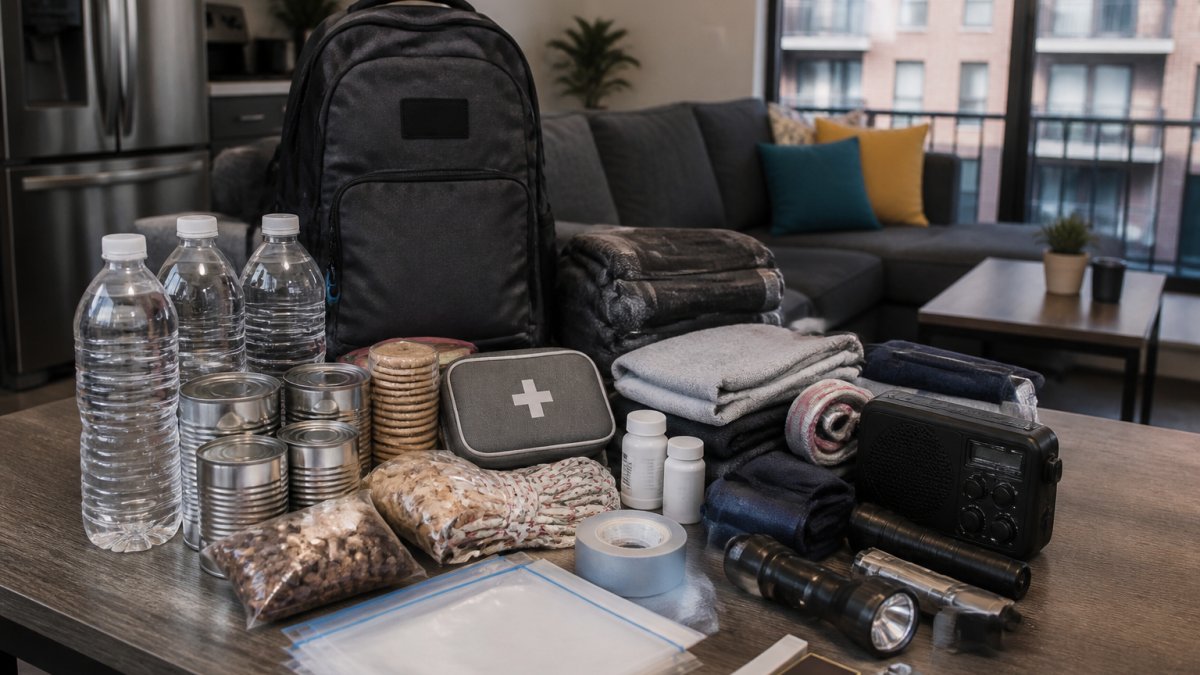
- Water: one gallon per person per day, three days minimum (roughly 8 pounds per gallon, split into two smaller containers so one hand stays free for the stair rail)
- Non-perishable food: three days, no cooking required
- First aid kit with any prescription medications, seven-day supply
- Battery-powered radio and spare batteries
- Flashlight or headlamp for every person
- Portable power bank, charged
- Copies of lease agreement, renter's insurance, and IDs in a waterproof pouch
- Whistle, dust masks, and work gloves
- Cash in small bills
- Sturdy closed-toe shoes stored next to the bag, not in it
Shelter-in-Place Cache (Stay-Put Tier)
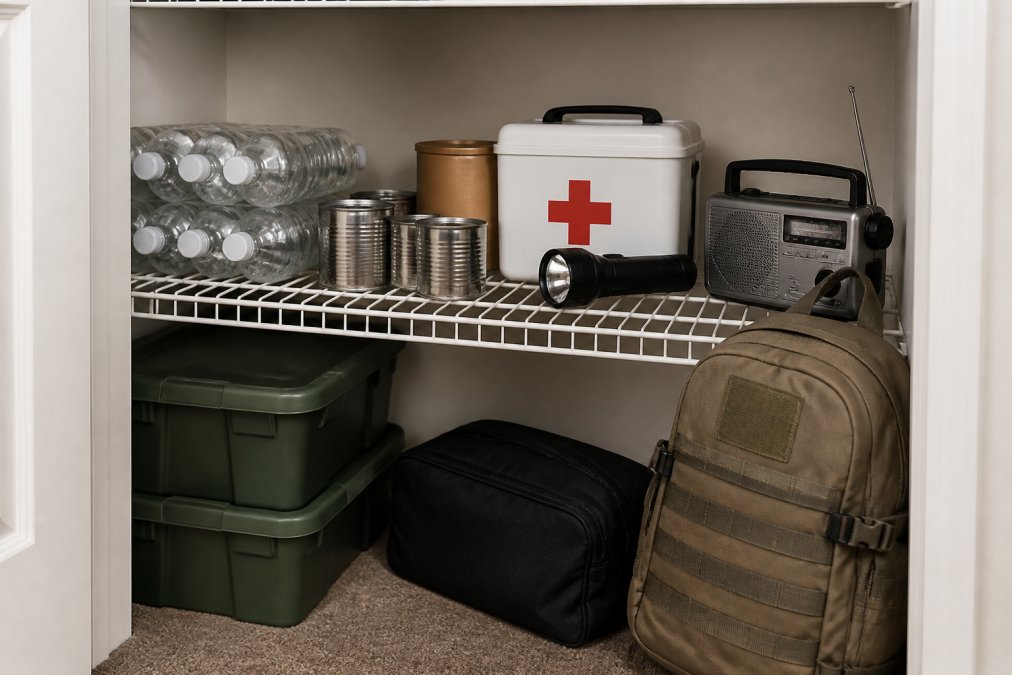
This tier lives in a closet, under a bed, or on a top shelf and does not need to be portable. It assumes you may be without power, water pressure, or elevator service for several days.
- Additional water: a two-week supply if space allows, stored low and in stackable containers
- Extra food that requires no cooking
- A bucket-style toilet solution and waste bags, since water pressure often fails in a regional outage
- Duct tape and plastic sheeting for sealing a door or window
- A battery-powered carbon monoxide detector if your unit has any fuel-burning appliance
- A fire extinguisher rated for kitchen fires (look for a Class A-B-C or K rating on the label)
- A printed copy of your building's evacuation map and your out-of-area contact number
Water and Non-Perishable Food Storage for Small Spaces
Water storage is the hardest part of apartment preparedness. A three-day supply for two people is six gallons, roughly 50 pounds. Store it low, under the bed or on the closet floor, in stackable containers rather than loose jugs. If your lease or building rules restrict large water containers, rotate smaller bottles and refill them from the tap before a forecast storm.
First Aid Kit and Important Documents
Your first aid kit should match your household, not a generic list. Add children's medications, pet supplies, or mobility aids as needed. Check expiration dates on medications and antiseptics once a year, ideally when you rotate your food stock.
Emergency Power for Apartments: What Actually Works
Emergency power for apartments comes down to batteries and one decision: how much you need. Generators are usually off the table because of lease rules, fuel storage bans, and carbon monoxide risk in shared buildings. That leaves three tiers.
| Option | Best For | Runtime | Notes |
|---|---|---|---|
| Portable power bank | Phones, small lights | 1-3 days | Cheapest entry point |
| Battery-powered radio | News and alerts | Weeks on AAs | Non-negotiable for outages |
| Portable power station | CPAP, small fridge, charging | Hours to days | Heaviest, most capable |
High-Rise Building Evacuation Plan: Stairwells, Routes, and Timing
A high-rise building evacuation plan needs three things: two stairwell routes, a meeting point, and a realistic time estimate. Walk both stairwells today and time yourself. Most people descend a flight in about 20 seconds when moving steadily, so a 15-story building means roughly five minutes of continuous descent before you account for crowding. Add time for smoke, darkness, and neighbors moving the opposite direction.
Know these details before you need them:
- Which stairwells are enclosed and pressurized
- Where the fire doors sit on your floor
- Whether your building has a voice alarm or an emergency alert system
- Your building management's stated evacuation procedure
- Which stairwells discharge to the street versus into a lobby or garage
Vertical Evacuation Logistics
Three logistics deserve their own plan:
Stairwell congestion. In a full-building evacuation, a single stairwell can carry only so many people per minute. If you are able-bodied and on a lower floor, starting early matters more than packing perfectly. If you are on a high floor, expect to wait and plan for it: keep a headlamp on your person so you are not dependent on stairwell lighting, and stay to the right so responders moving up can pass.
Practice the Walk, Not Just the Plan
A written plan you have never walked is a guess. Once a year, take your go-bag and descend both stairwells to your meeting point. Time each route, note where the lighting is poor, and check whether any stairwell door is propped open or blocked by stored items, a common problem in buildings where residents use stairwells for storage. Report blocked stairwells to building management in writing so there is a record.
Apartment-Specific Fire Safety and Shelter-in-Place
Apartment fire safety starts with what you can inspect yourself. Test your smoke detector monthly, confirm a fire extinguisher is within reach, and learn where the nearest alarm pull station sits. If your building's alarms are unreliable, a battery-powered smoke detector inside your unit is cheap insurance.
Family Communication and Digital Preparedness
Digital preparedness is the most overlooked piece of apartment emergency planning. Cell networks overload in regional disasters, so agree on a plan before you need it.
- Pick one out-of-area contact everyone calls or texts. Long-distance lines often work when local ones fail.
- Set up a group chat and a backup app that works over Wi-Fi.
- Store your emergency contact list in the cloud and on paper.
- Photograph your lease agreement, insurance documents, and IDs, then back them up.
- Keep a written list of medications, allergies, and pet records.
Pet-Specific Apartment Evacuation
Pet-specific apartment evacuation needs its own bag, because animals change your exit math. A cat carrier takes one hand you needed for the stair rail. A large dog may not be allowed in a shelter.
Conclusion: Start With One Closet
The gap between prepared and unprepared apartment dwellers is rarely gear. It is one afternoon of planning: a timed stairwell walk, a filled go-bag, and a family communication plan everyone has actually read.
Frequently Asked Questions
What are the 5 P's of preparedness?
The 5 P's are people, personal items, prescriptions, paperwork, and practical supplies. In an apartment context, people covers your household and pets; personal items include clothing and hygiene basics; prescriptions means at least a 7-day supply of medication; paperwork covers insurance documents and IDs in a waterproof bag; and practical supplies includes your emergency kit, water, and non-perishable food. Building your apartment emergency preparedness plan around these five categories keeps nothing important overlooked.
How do you store emergency supplies in a small apartment?
Use vertical and hidden space. Store water and non-perishable food under beds in low-profile bins, on the top shelf of closets, and inside ottomans or storage benches. Keep your go-bag by the front door. A battery-powered radio, portable power bank, and first aid kit fit in a single labeled tote. Rotate food and water every six months so nothing expires. Small-space storage works when every item has a fixed spot you can reach in the dark.
What should be in an apartment emergency go-bag?
An apartment go-bag should hold three days of supplies: one gallon of water per person per day, non-perishable food, a flashlight, a battery-powered radio, a portable power bank, a first aid kit, any prescriptions, a change of clothes, and copies of insurance documents and IDs in a waterproof pouch. Add a whistle, dust mask, and sturdy shoes for stairwell evacuation. Keep the bag under 20 pounds so you can carry it down multiple flights of stairs without slowing down.
How do you prepare for a power outage in a high-rise building?
Start with light and communication: a battery-powered radio, flashlights for every room, and a portable power bank for phones. Keep your refrigerator and freezer closed to preserve food. If your building has a generator, confirm with building management which outlets and elevators it powers. Never use a gas generator, camp stove, or charcoal grill indoors or on a balcony; carbon monoxide kills. If the outage lasts more than a few hours and stairwells are lit, consider relocating to a friend's home at ground level.
What are the essential documents to keep in an emergency kit?
Store copies of your lease agreement, renter's insurance policy, photo IDs, birth certificates, Social Security cards, medical prescriptions, and emergency contact list in a waterproof bag inside your go-bag. Keep digital scans in encrypted cloud storage as a backup. After a fire or flood, these documents speed up insurance claims and replacement of IDs. Refresh copies annually and after any lease renewal or policy change.
Is AC broken an emergency if living in an apartment?
A broken AC is not a life-threatening emergency in mild weather, but it becomes one during extreme heat, especially for elderly residents, infants, or anyone with a chronic condition. If indoor temperatures climb above 90°F, treat it as a health risk: use battery-powered fans, wet towels, and cool showers, and relocate to a cooling center or a friend's home if you cannot bring the temperature down. Report the outage to building management immediately and document it in writing.
Where is the safest place to be in an apartment during an earthquake?
Drop, cover, and hold on under a sturdy table or desk, away from windows, mirrors, and tall furniture. If no table is nearby, crouch against an interior wall and shield your head and neck with your arms. Do not run for the stairwell during shaking; most injuries happen from falling debris while moving. Once shaking stops, put on sturdy shoes, grab your go-bag, and use the stairs, never the elevator, to exit if the building is damaged.
What are 10 items in an emergency go bag?
A solid go-bag holds: (1) one gallon of water per person per day, (2) non-perishable food, (3) a flashlight, (4) a battery-powered radio, (5) a portable power bank, (6) a first aid kit, (7) a 7-day supply of prescriptions, (8) copies of insurance documents and IDs, (9) a change of clothes and sturdy shoes, and (10) a whistle and dust mask. For apartment dwellers, add a small fire extinguisher rated for kitchen fires and a laminated emergency contact list.