
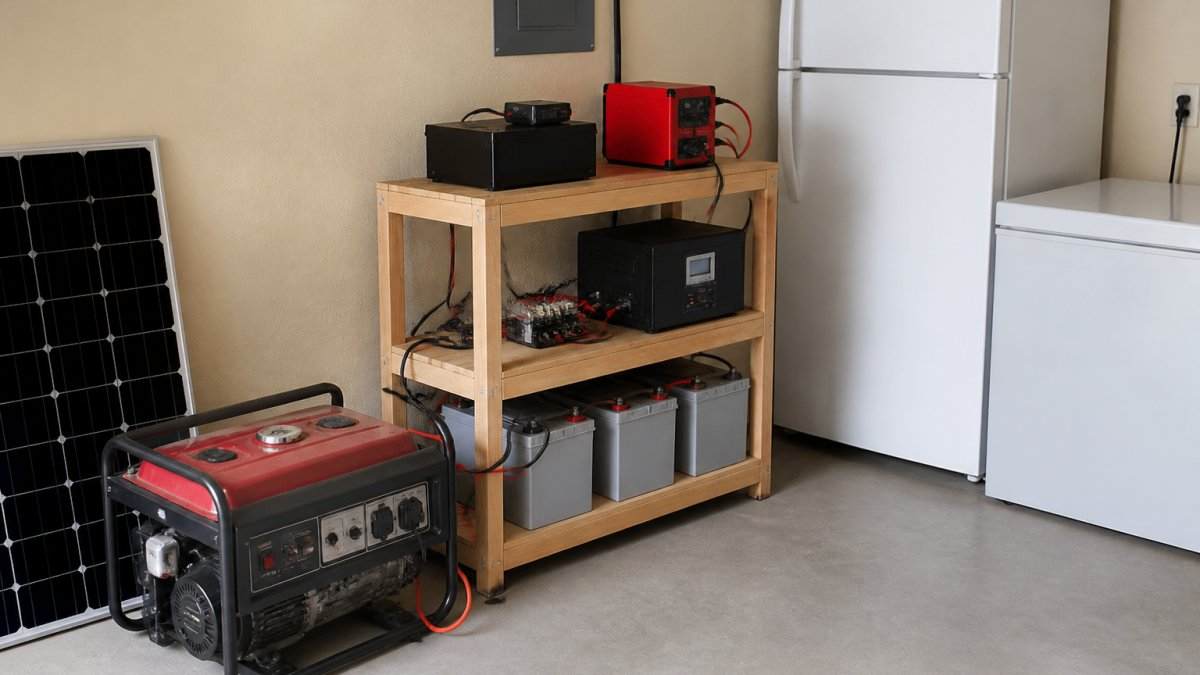
Table of Contents
- Understanding Your Emergency Power Backup Needs
- Calculating Battery Capacity for Your Appliances
- Backup Power for Your Refrigerator During an Outage
- Building a Battery-Based System Without Solar
- Connecting Your Battery Backup System Safely
- Generator Safety During a Power Outage
- Testing, Maintenance, and Outage Readiness
- Frequently Asked Questions
Last Updated: October 17, 2026
Understanding Your Emergency Power Backup Needs
When the power goes out, your home becomes vulnerable. A diy emergency power backup for home appliances keeps essential systems running and protects your family during outages. Before you buy anything, you need to know what you're actually powering and for how long.
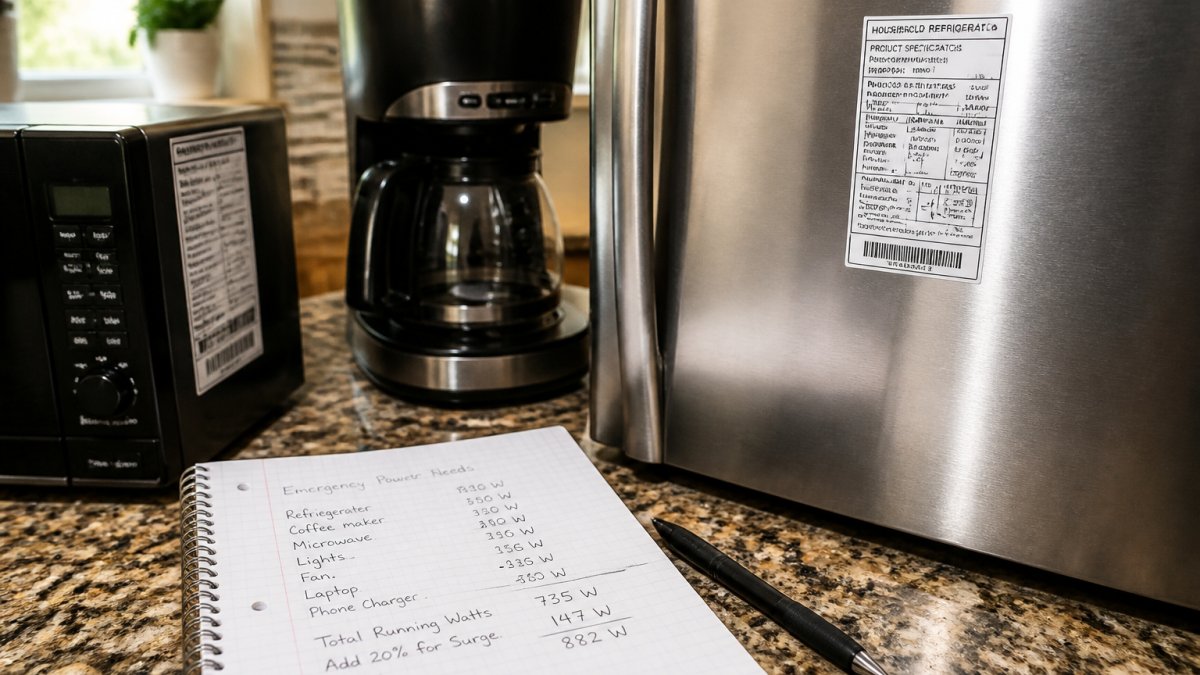
The first step is identifying which appliances matter most. Not everything needs backup power. Your goal is to keep critical loads running during an outage, not to power your entire home indefinitely.
Start by walking through your house and listing what you'd miss most. For most households, this includes:
- Refrigerator or freezer
- Lights and outlets
- Modem and WiFi router
- Phone chargers
- Medical equipment (if applicable)
- Sump pump (if you have one)
- Well pump (if applicable)
Identifying Essential Loads and Appliances
Essential loads are the appliances you absolutely need during a power outage. Your refrigerator keeps food safe. Your lights let you see. Your modem keeps you connected to emergency information.
Medical devices top the priority list. If someone in your home uses a CPAP machine, oxygen concentrator, or insulin pump, that's your first load. Everything else comes second.
Write down every appliance you want to power. Include:
- How long you want to run it (hours or days)
- How often it cycles on and off
- Whether it needs to run continuously or just occasionally
This list becomes your sizing guide. We help families identify these loads before they build a backup power system, because guessing wrong wastes money and leaves you unprepared.
Estimating Appliance Wattage and Energy Use
Every appliance has a power rating. Find it on the device's label or in the manual. The label shows watts or kilowatts.
Running watts are what the appliance uses during normal operation. A typical refrigerator uses 600-800 running watts. LED lights use 8-12 watts each.
Starting watts (also called surge watts) are the extra power needed when an appliance first turns on.
Make a simple table:
| Appliance | Running Watts | Starting Watts | Hours per Day |
|---|---|---|---|
| Refrigerator | 700 | 2100 | 24 |
| Lights (5 LED bulbs) | 50 | 50 | 8 |
| Modem | 8 | 8 | 24 |
| Laptop | 65 | 65 | 8 |
| Phone charger | 10 | 10 | 2 |
Add up your running watts. This is your continuous load. Add up your starting watts to find your peak demand. Your inverter must handle the peak.
Calculating Battery Capacity for Your Appliances
Battery capacity determines how long your system runs. Get this wrong and you'll run out of power halfway through an outage. Get it right and you have real peace of mind.
Understanding Watt-Hours and Runtime
Watt-hours measure energy storage. A 5,000 watt-hour battery stores 5,000 watts of power for one hour, or 1,000 watts for five hours.
The formula is simple:
Watt-hours needed = (Running watts) × (Hours of runtime desired)
Say you want to run 1,000 watts of appliances for 8 hours. You need 8,000 watt-hours of capacity.
But here's the catch: you can't use 100% of a battery's capacity. Lithium batteries let you use 80-95% of their rated capacity.
So if you want 8,000 usable watt-hours from a lithium battery, buy a 9,000 watt-hour battery (8,000 ÷ 0.89).
This is where most DIY builds fail. People buy a battery that looks big enough, then run out of power because they didn't account for the usable capacity.
Sizing Your Battery Bank
Start with your essential loads. Add up the running watts. Decide how many hours you want to run.
Example: 4-hour outage backup
- Refrigerator: 700 watts
- Lights: 50 watts
- Modem: 8 watts
- Laptop: 65 watts
- Total: 823 watts
For 4 hours: 823 × 4 = 3,292 watt-hours needed
With lithium (80% usable): 3,292 ÷ 0.80 = 4,115 watt-hour battery
With lead-acid (50% usable): 3,292 ÷ 0.50 = 6,584 watt-hour battery
Round up to the nearest standard size. A 5,000 watt-hour lithium battery or a 7,000 watt-hour lead-acid battery would work.
For longer outages, multiply accordingly. An 8-hour outage needs double the capacity. A 24-hour outage needs six times the capacity.
Most households find that 5,000-10,000 watt-hours covers 4-12 hours of essential loads.
Backup Power for Your Refrigerator During an Outage
Your refrigerator is usually the biggest draw. It cycles on and off throughout the day, so it doesn't run continuously.
Backup power for refrigerator during outage planning means accounting for this cycling. Over 24 hours, a typical refrigerator consumes 4,000-6,000 watt-hours, not 14,400-19,200 watt-hours.
To keep a refrigerator running for 24 hours, plan for 6,000 watt-hours of usable capacity.
The refrigerator will work normally. It will cool down, cycle off, and cycle back on as needed. Your battery system won't notice the difference.
Pro Tip: Keep your refrigerator at 37-40°F before the outage. A cold fridge uses less power to maintain temperature than a warm one.
Building a Battery-Based System Without Solar
You don't need solar panels to build a working backup power system. Many homes use grid charging instead, which is simpler and cheaper upfront.
Choosing Battery Chemistry and Capacity
Lithium (LiFePO4) batteries are the modern choice. They last 10+ years, charge and discharge efficiently, and let you use 80-95% of their capacity. They cost more upfront but deliver better value over time.
Lead-acid batteries are cheaper initially but last 3-5 years and only let you use 50% of capacity safely. They're heavier and need more maintenance.
For a DIY system without solar, lithium makes sense. You'll charge from the grid, so you don't need the ruggedness of lead-acid.
Choose your capacity based on your load calculations. A 5,000-10,000 watt-hour lithium battery covers most household needs for 4-12 hours.
Selecting and Sizing Your Inverter
The inverter converts DC power from your battery into AC power for your appliances. Size it to handle your peak starting watts, not your running watts.
If your highest starting load is 2,500 watts (refrigerator plus lights plus modem), buy a 3,000-watt inverter. Don't buy a 2,000-watt inverter and hope it works. It won't.
Inverters come in two types:
- Pure sine wave outputs AC power that matches grid power exactly. All appliances work normally. This is what you want.
- Modified sine wave is cheaper but can damage sensitive electronics. Avoid it.
For a diy emergency power backup for home appliances, get a pure sine wave inverter rated for your peak load with 20% headroom.
Grid Charging Your Battery Bank
Without solar, you charge your battery from the grid using a charge controller. This device takes AC power from a wall outlet and converts it to DC power for the battery.
Connect the charger to a standard 120V or 240V outlet. The charger will fill your battery slowly and safely. A 5,000 watt-hour battery might take 8-12 hours to charge fully on a standard 120V outlet.
For faster charging, use a 240V outlet. This cuts charging time in half.
Keep your battery charged before an outage. Don't wait until the power goes out to start charging. A fully charged battery means you're ready immediately.
Connecting Your Battery Backup System Safely
This is where most DIY mistakes happen. Improper wiring causes fires, electrocution, and battery damage. Follow these steps carefully.
Wiring Basics: DC Power and AC Power
DC power flows from your battery. It's low voltage but high current. It can cause severe burns if you touch it wrong.
AC power flows from your inverter to your appliances. It's higher voltage but lower current. Standard household wiring handles it safely.
Never mix DC and AC wiring. Use different wire gauges and colors. Red and black for DC (positive and negative).
Your battery connects to the inverter with thick DC cables. Thin wires can't handle the current and will overheat. Use cables sized for your system's amperage.
For a 5,000 watt-hour battery at 48V, you're looking at roughly 100 amps of current. Use 2-gauge or thicker cable for the DC run.
Installing a Transfer Switch
A transfer switch disconnects your backup system when the grid is running and connects it when the grid fails.
Manual transfer switches require you to flip a switch when power goes out. Automatic transfer switches detect the outage and switch instantly.
For a DIY system, a manual transfer switch is simpler and cheaper. You flip it when the power fails. Flip it back when power returns.
Wire the transfer switch between your electrical panel and your inverter. Never wire it directly to the grid. Improper installation can damage your system or create a safety hazard.
If you're not comfortable with electrical work, hire a licensed electrician. This isn't the place to save money.
Generator Safety During a Power Outage
If your backup power system runs out of battery, a generator can extend your runtime. But generators are dangerous.
Run your generator outside, at least 20 feet from windows and doors (the CDC). Carbon monoxide builds up quickly indoors and kills silently.
Never refuel a running generator. Turn it off and let it cool for 15 minutes first.
Don't connect your generator directly to your home's electrical panel. Use a transfer switch. Direct connection backfeeds power into the grid and electrocutes utility workers.
Use heavy-duty extension cords rated for outdoor use. Thin cords overheat and catch fire.
Store fuel in a proper gas can, outside, away from your home. Keep fuel away from heat sources.
Testing, Maintenance, and Outage Readiness
Your backup power system needs regular testing. A system you've never tested will fail when you need it most.
Monthly test:
- Turn off the main breaker to simulate an outage
- Check that the inverter activates
- Run a few appliances for 15 minutes
- Check battery voltage and state of charge
- Turn the main breaker back on
Quarterly test:
- Repeat the monthly test
- Run the system for 2-4 hours
- Monitor battery voltage and temperature
- Check for any unusual sounds or smells
Annual maintenance:
- Check all cable connections for corrosion
- Clean battery terminals with a wire brush
- Check battery voltage with a multimeter
- Verify the inverter's cooling fan works
- Test the transfer switch manually
Keep your battery charged year-round. A battery left uncharged for months will lose capacity or fail entirely.
Monitor battery temperature. Lithium batteries work best between 32°F and 104°F. In cold climates, insulate your battery box.
Track your system's performance. Write down the date, battery voltage before and after testing, and any issues.
We recommend testing your diy emergency power backup for home appliances at least quarterly. Families that test regularly catch problems before an outage happens.
Building a diy emergency power backup for home appliances takes planning, but it's achievable without professional installation.
Frequently Asked Questions
What can you use for backup power during a home outage?
You can use a battery bank paired with an inverter to power essential loads like refrigerators, lights, and electronics. Lithium or lead-acid batteries store energy charged from the grid or solar panels. A portable power station works for smaller loads. Generators provide backup power but require fuel and proper ventilation. A DIY emergency power backup system combines a battery bank, inverter, charge controller, and wiring to create a reliable home backup power solution without solar dependency.
How do you calculate the battery capacity needed for essential appliances?
Multiply each appliance's wattage by its daily runtime in hours to get watt-hours. For example, a 600-watt refrigerator running 8 hours per day uses 4,800 watt-hours. Add watt-hours for all essential loads, then multiply by your desired backup duration (typically 1-3 days). Divide by your battery's usable capacity (usually 80-90% of rated capacity) to find the total battery capacity needed. A battery capacity calculator for appliances helps automate this process and ensures you size your system correctly.
Can a battery backup power a refrigerator during an outage?
Yes, a properly sized battery backup can run a refrigerator during an outage. Most refrigerators draw 600-800 watts when the compressor runs. You need a battery bank with enough capacity to supply continuous power for your desired backup duration, plus an inverter rated for the refrigerator's starting surge (typically 1,200-2,000 watts). A dedicated backup power for refrigerator during outage setup ensures your food stays cold without relying on grid power or a noisy generator.
Is it safe to use a generator indoors during a power outage?
No, never run a generator indoors, in a garage, basement, or any enclosed space. Generators produce carbon monoxide, a deadly odorless gas that can kill in minutes. Always operate generators outside, at least 20 feet away from windows, doors, and vents. Point the exhaust away from your home. Use a heavy-duty outdoor-rated extension cord to deliver power safely. Generator safety during power outage requires proper ventilation, grounding, and regular maintenance to prevent electrical hazards and fuel leaks.