
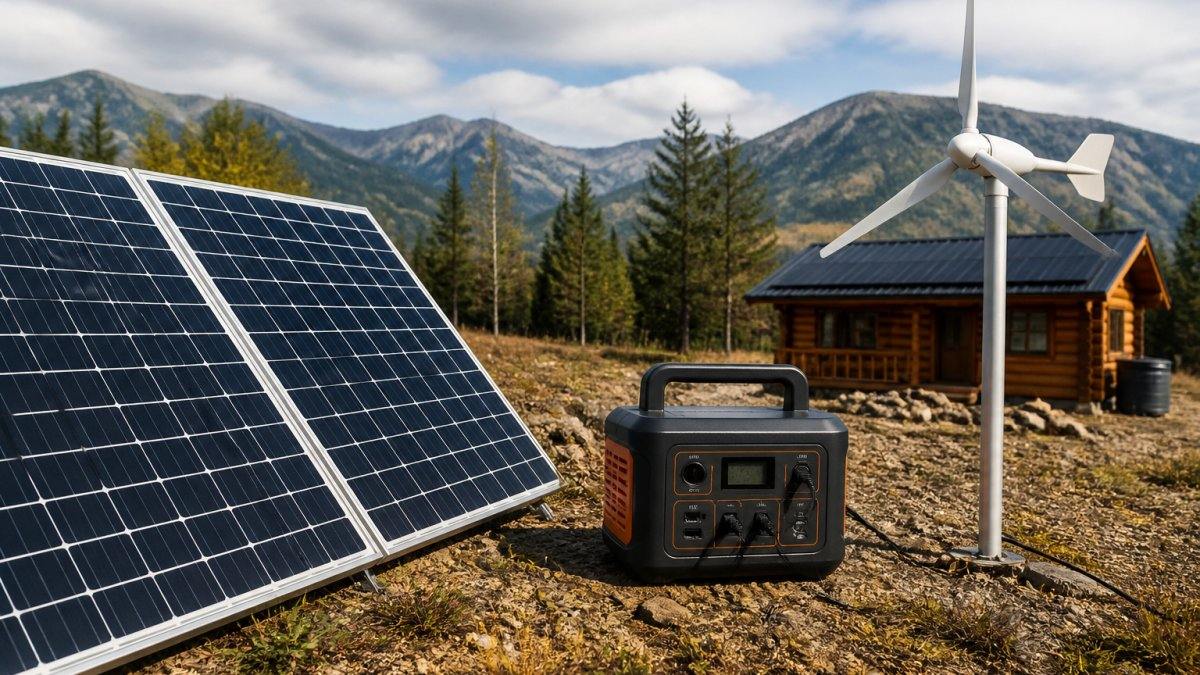
Table of Contents
- Why Renewable Energy Sources Matter When the Grid Goes Down
- Quick Comparison: Survival Renewable Energy Sources at a Glance
- Off-Grid Solar Power System: The Most Practical Starting Point
- Wind Turbines for Home Backup Power: Strong Output, Real Limits
- Micro Hydro Power for Off-Grid Homes: The Most Consistent Option
- Renewable Energy Storage for Emergencies: Batteries and Backup Duration
- Choosing the Best Renewable Energy Sources for Survival by Location
- Frequently Asked Questions
Last Updated: October 16, 2026
Why Renewable Energy Sources Matter When the Grid Goes Down
The best renewable energy sources for survival are solar, wind, micro hydro, and battery storage working together.
A blackout is not a rare event. Storms, heat waves, and grid strain knock out power every year.
Renewable energy is power you make yourself.
The U.S. Department of Energy's guide to renewable energy breaks these sources into simple categories.
Here's what most guides get wrong: they rank sources by cost or carbon, not by whether they keep your family warm at 2 a.m. during an outage. We rank them by survival value.
Below, we compare each option on reliability, storage, and upkeep. You'll also get a location-based way to pick the right one.
Quick Comparison: Survival Renewable Energy Sources at a Glance
Solar wins for most homes because it is simple to install and works almost anywhere. Wind and micro hydro produce more consistent power but need specific site conditions. Here is how the four main options stack up.
| Source | Best For | Main Limit | Backup With Storage |
|---|---|---|---|
| Solar | Most homes, suburbs | No sun at night | Yes, strong |
| Wind | Open, windy land | Needs steady wind | Yes, strong |
| Micro hydro | Property with a stream | Needs flowing water | Yes, constant |
| Battery bank | All of the above | Limited run time | Core of any system |
A quick rule: if you have sun and a roof, go solar first. Add storage next. Only chase wind or water if your land clearly supports them.
Off-Grid Solar Power System: The Most Practical Starting Point
An off-grid solar power system is the easiest renewable setup for most families to start with. Panels need no fuel, have no moving parts, and last for decades.
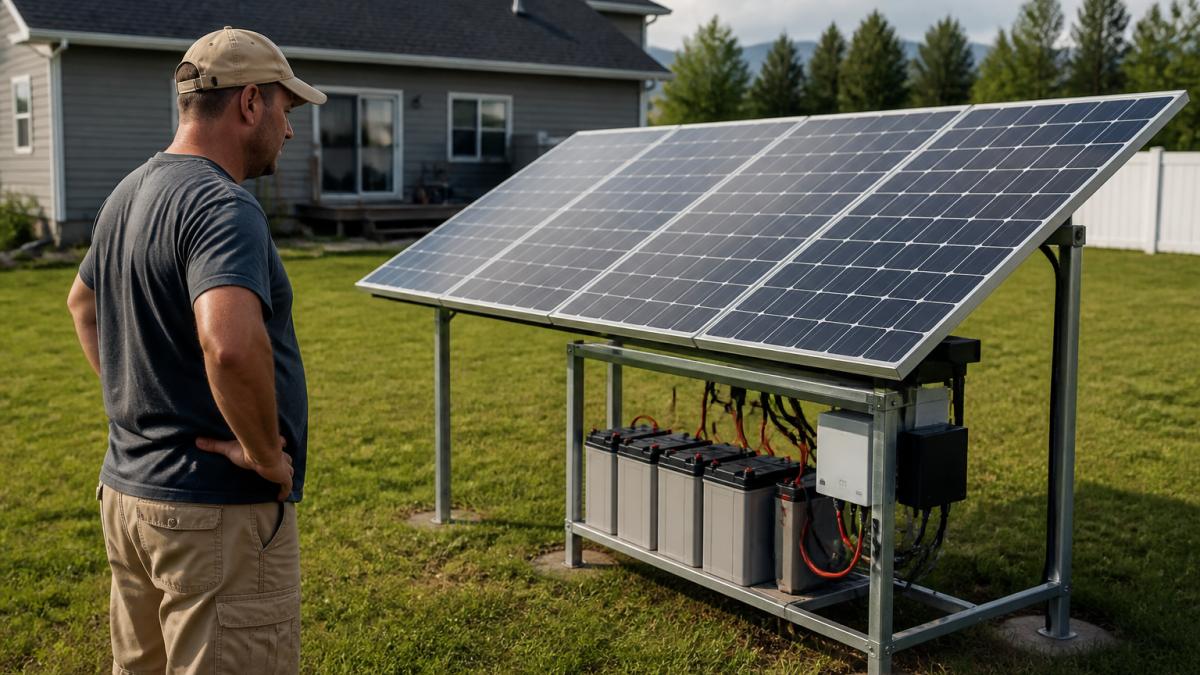
The catch is the sun. Panels make nothing at night and less on cloudy days. So solar only works as survival power when you pair it with batteries.
How Much Solar Power You Need for Essential Loads
Start with your essential loads, not your whole house. Most families only need to run a few things during an outage.
- Fridge or freezer: keeps food safe
- A few LED lights: for evenings
- Phone and radio charging: for info and contact
- Medical devices: if anyone depends on them
- A small fan or heater: for comfort
Add up the watts each item uses, then multiply by the hours you run it. That total tells you the panel and battery size you need. Size for winter sun, not summer, and you won't run short.
Wind Turbines for Home Backup Power: Strong Output, Real Limits
Wind turbines for home backup power can run day and night, which solar cannot. That round-the-clock output is their biggest edge. The problem is that most homes do not sit on good wind.
Turbines need steady, strong wind to pay off. Gusty or blocked sites produce little. Trees, buildings, and hills all cut wind speed.
A common mistake is buying a small turbine before checking the site. Measure wind for months first, or talk to a local installer.
Micro Hydro Power for Off-Grid Homes: The Most Consistent Option
Micro hydro power for off-grid homes is the most reliable renewable source when you have moving water. A stream that flows year-round can produce power around the clock. No sun, no wind, no problem.
The trade-off is site access. You need a creek or spring with steady flow and a drop in elevation. Many properties simply do not have this.
Where it fits, micro hydro is hard to beat. It runs in rain or dark, and it needs little upkeep once built.
Renewable Energy Storage for Emergencies: Batteries and Backup Duration
Renewable energy storage for emergencies decides how long your power lasts. Panels and turbines make power in the moment. Batteries save it for when you need it. Most guides stop at naming battery types. The survival question is different: how many days can this bank carry your critical loads when the sun does not shine and the wind does not blow?
The Math That Actually Matters
Battery capacity is rated in kilowatt-hours (kWh). Usable capacity is smaller than rated capacity because you should not drain most batteries to zero.
- Lithium iron phosphate (LiFePO4): roughly 80-90% usable depth of discharge, 3,000-6,000 cycles, higher upfront cost
- Flooded lead-acid: roughly 50% usable depth of discharge, 500-1,200 cycles, lowest upfront cost, needs watering and venting
- Sealed AGM/GEL: roughly 50% usable depth of discharge, 500-1,000 cycles, no watering, sensitive to overcharging
- Portable power stations: lithium inside, easy to move, best for small loads and short outages
A simple planning formula:
Usable kWh = rated kWh × depth of discharge Runtime (days) = usable kWh ÷ daily critical-load kWh
Example: a 10 kWh LiFePO4 bank at 85% depth of discharge gives about 8.5 usable kWh. If your critical loads draw 2 kWh per day, that is roughly four days with no generation. The same 10 kWh in lead-acid at 50% gives about 5 usable kWh, roughly two and a half days.
Sizing Around Critical Loads, Not the Whole House
Estimate daily critical-load kWh before you buy anything:
- Refrigerator or freezer: often 1-2 kWh per day depending on size and climate
- LED lighting (four to six bulbs, evening use): under 0.3 kWh per day
- Phone, radio, and small electronics charging: under 0.2 kWh per day
- Medical device (CPAP, concentrator, etc.): check the label, some draw 0.5-2 kWh per night
- Water pump or well pump: highly variable; a shallow-demand pump may draw 0.5-1.5 kWh per day
- Small fan or space heater: a heater can dwarf everything else, plan it separately or use propane
Add these up, then size the bank for two to three days of autonomy as a common baseline, and more if you live where winter storms routinely cut power for a week.
The Rest of the System
A battery bank is not a standalone product. It needs:
- A charge controller (MPPT for solar) to regulate incoming power and protect the bank
- An inverter to convert DC to AC for household devices, with efficiency losses typically in the 10-15% range
- Proper fusing, disconnects, and ventilation, especially for lead-acid
- A backup charger, a small generator or grid connection, to refill the bank during long stretches without sun or wind
Backup Duration by Source
- Solar plus storage: strong by day, limited at night and in multi-day overcast; duration depends entirely on bank size
- Wind plus storage: can recharge around the clock when wind blows, but calm spells can last days
- Micro hydro plus storage: the most consistent recharge because flow continues day and night, so the bank rarely drains fully
- Generator as charger: extends any system indefinitely as long as fuel lasts, which is the real constraint in a prolonged outage
The takeaway: storage is the survival system. Generation just refills it. Size the bank to your loads and your worst-case weather, and keep a fuel-based backup charger for the days when nothing else produces.
Choosing the Best Renewable Energy Sources for Survival by Location
The best renewable energy sources for survival depend on where you live. There is no single winner. Your site decides. The survival decision is a siting question. Work through these factors in order before you spend a dollar.
1. Sun Exposure
- How many hours of unobstructed sun does your best roof or yard spot get in December, not June?
- Are there trees, hills, or buildings that shade the array mid-day?
- Does your region get multi-day overcast stretches in winter?
If winter sun is weak or blocked, solar alone will not carry you, plan for more storage or a second source.
2. Wind Consistency
- Average wind speed matters less than how steady it is. Gusty, turbulent sites underperform.
- Trees, buildings, and terrain within a few hundred feet create turbulence that cuts output.
- A common pattern is that a site feels windy at ground level but is marginal at turbine height, or vice versa. Measure for months before committing.
3. Water Flow and Drop
- Micro hydro needs both flow (volume per minute) and head (vertical drop). One without the other will not work.
- Does the stream flow year-round, or does it drop to a trickle in late summer?
- Water rights and permits are real constraints in many areas, check before you dig or divert.
4. Climate and Seasonality
- Cold climates favor solar in clear winter air but stress batteries, which lose capacity in freezing temperatures.
- Hot climates favor solar output but shorten battery life and increase cooling loads.
- Hurricane, wildfire, and ice-storm regions each create different failure modes, plan for the one that hits you.
5. Land, Access, and Zoning
- Roof space, yard space, and distance from the battery bank all affect cost and voltage drop.
- Many jurisdictions require permits for panels, turbines, and water systems. Check local rules before installing anything.
A Simple Decision Path
- Sunny, open lot with reliable winter sun: solar first, add storage, add wind only if the site is genuinely breezy
- Wooded or cloudy area with no water: lean on a generator charged by stored fuel, supplemented by whatever solar you can capture
- Property with a year-round stream and drop: micro hydro plus storage is the most consistent option
- Apartment, rental, or small space: portable solar panels and power stations, sized to your smallest critical loads
- Mixed site: solar as the base, wind or hydro as the recharge source, storage as the buffer
A FEMA guide to powering your home during an outage is a good place to start planning, and your state or county extension office often has local wind and solar resource data.
Whatever you pick, build around storage. Power you cannot save is power you cannot use at night. And whatever you build, plan for the season that is worst for your site, not the one that is best.
Frequently Asked Questions
What is the most effective renewable energy source for survival?
Solar energy is the most practical starting point for most households because panels have no moving parts, work in nearly every climate, and scale from a few hundred watts to a full home system. Wind and micro hydro can produce more consistent output, but they depend on site conditions. For most families, a solar array paired with battery storage delivers the best balance of reliability, low maintenance, and simple installation.
Is solar or wind power more reliable during an emergency?
Solar is more reliable in most emergency scenarios. Panels produce power whenever sunlight is available and need almost no maintenance, while wind turbines depend on sustained wind speed and have moving parts that wear out. A small turbine can supplement a solar setup in windy areas, but it should not be the only source. Combining both with battery storage gives you the most dependable off-grid power.
How much renewable energy storage do you need for emergencies?
Size storage around your essential loads, not your whole house. A typical emergency setup runs a refrigerator, lights, phone chargers, and a medical device, which draws roughly 1 to 2 kilowatt-hours per day. A battery bank with 5 to 10 kilowatt-hours of usable capacity covers two to five days without sun or wind. Add capacity if you run a well pump, sump pump, or space heater.
Can micro hydro power an off-grid home year-round?
Micro hydro can run year-round if you have a reliable water source with consistent flow and at least a few feet of drop. It produces steady power day and night, which makes it the most consistent renewable option for off-grid homes. The catch is site requirements: you need legal water rights, year-round flow, and a stream or spring on your property. Without those, solar and storage remain the practical choice.
When the grid goes down, the families who stay ready are the ones who planned ahead. SHTF Prepper Club makes that simple with expert-vetted power, food, water, and safety gear. Our comprehensive preparedness guides walk you through each step, and our long-term food storage holds up for up to 25 years. Get started with SHTF Prepper Club and keep your household ready for any outage.