

Last Updated: November 21, 2026
Quick Summary
There’s no single backup runtime. Estimate it by dividing the usable energy available at the start of the outage by the average power draw of the circuits you plan to run. Your actual runtime depends on usable capacity, the loads you choose to carry, and whether solar recharges the battery during the outage.
- A 5 kWh usable battery carrying a 0.3 kW average load runs roughly 16 hours on essentials.
- Adding a 1.5 kW space heater to a 10 kWh battery cuts runtime to roughly 4 hours.
- Estimate runtime by dividing usable capacity in kWh by your average load in kilowatts.
- Your inverter must handle startup surges, not just steady load, or it trips even when average draw looks fine.
- Plan for the longest stretch without sun, since winter nights and cloud cover cut solar recharging.
Table of Contents
- Two Different Questions: Runtime Versus Lifespan
- How Long Can a Solar Battery Power a House During an Outage
- Battery Capacity, Usable Capacity, and Your Household Load
- How Long Will My Solar Battery Last Calculator: Worked Examples
- Lithium-Ion Solar Battery Lifespan and the Chemistry Comparison
- How Long Does a Solar Battery Last at Night
- What Shortens a Home Battery's Service Life
- Sizing Your Family's Backup Before the Next Outage
- Frequently Asked Questions
Two Different Questions: Runtime Versus Lifespan
"How long do home battery backups last" has two answers, and mixing them up is the most common mistake we see. Runtime is how many hours a battery keeps your house running during one outage; lifespan is how many years it stays useful before replacement.
A home battery backup is a rechargeable energy storage unit that powers selected circuits in your house when grid power fails. It stores energy in chemical form and releases it through an inverter as household electricity.
Runtime is measured in hours; lifespan in years and charge cycles.
Both numbers matter for family planning, but they answer different questions. For the years side, see our guide on how long solar batteries last.
How Long Can a Solar Battery Power a House During an Outage
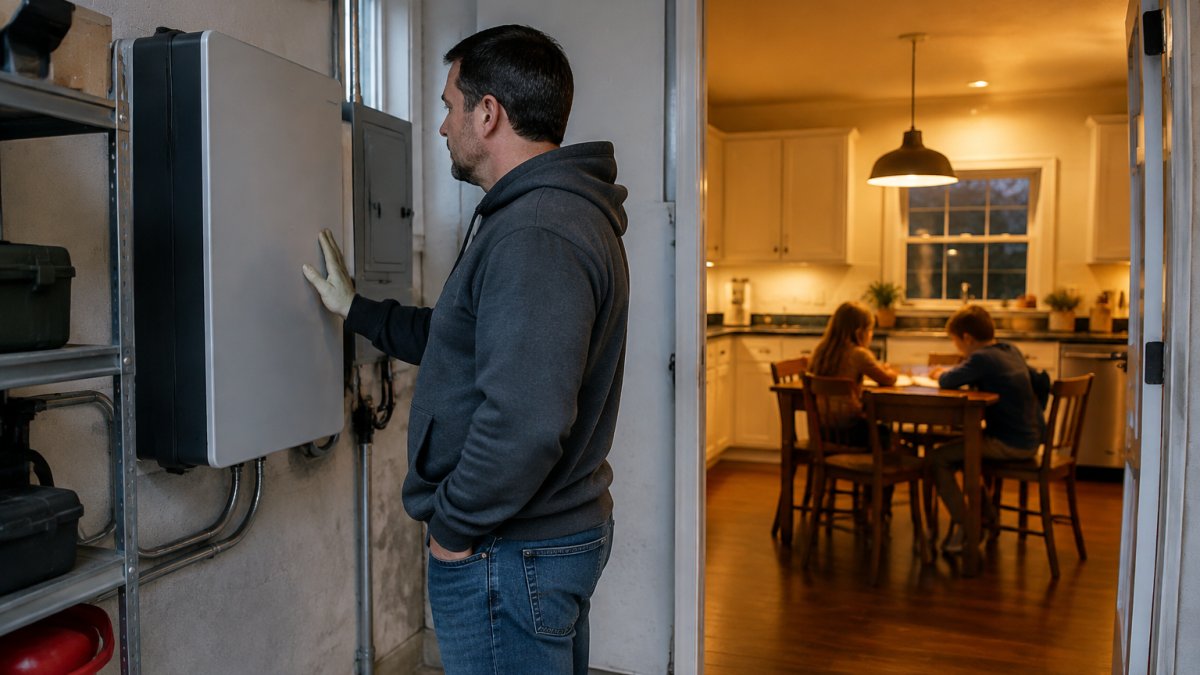
For a rough estimate, a battery with 10 kWh available at the start of an outage can support a steady 0.5 kW load for about 20 hours, or a 2 kW load for about 5 hours, before accounting for system losses. Running only essential circuits generally extends runtime; check available charge and reserve settings before relying on the estimate.
Three Outage Strategies and What Each Buys You
Essential circuits only. You keep the refrigerator, a few lights, the router, phone chargers, medical equipment, and a sump pump.
Partial home. You add a space heater, a window AC unit, or a well pump, the loads that collapse runtime. A 10 kWh usable battery carrying 0.8 kW runs about 12 hours.
Whole home. You carry central air, an electric water heater, and an electric range.
Short Outages Versus Multi-Day Outages
A few-hour outage is a convenience problem. A multi-day outage is a load-shedding problem.
A practical multi-day plan staggers the big loads: run the refrigerator in cycles, heat water or run the well pump during daylight when solar is feeding the battery, and charge devices at midday.
Watch out: sizing a battery to your average load and ignoring startup surges is the mistake that leaves families with a dead outlet when the fridge tries to restart.
How Solar Recharging Changes the Answer
Without solar, runtime is fixed by usable capacity.
A common pattern is a system that covers essentials indefinitely in clear summer weather and falls short in winter, when shorter days, lower sun angles, and cloud cover cut production while overnight loads grow.
Treat solar as a daily recharge budget, not a guarantee. On good days, bank surplus; on poor days, shed loads early rather than waiting for the battery to empty.
Battery Capacity, Usable Capacity, and Your Household Load
Battery capacity is the total energy a battery can store, measured in kilowatt-hours (kWh).
Usable capacity varies by battery chemistry and model, so check the manufacturer's stated usable capacity rather than the nominal rating.
Your household load is the total watts your home draws at any moment. A refrigerator cycles on and off. Lights and routers pull a small, steady amount.
To estimate runtime, divide usable capacity by your average load in kilowatts.
If you are still working out how much power your family actually needs, our guide on how much backup power your family needs walks through it appliance by appliance.
Essential Circuits Versus Whole-Home Backup
Essential circuits are the specific breakers you choose to power during an outage. Whole-home backup powers everything, including the big loads.
Most families are better served by essential circuits. Typical picks:
- Refrigerator and freezer
- Lights in main rooms
- Phone and device chargers
- Internet router and modem
- Medical equipment
- Sump pump
- A few outlets for a space heater or fan
Whole-home backup is convenient but demands far more capacity. If you run central air, an electric water heater, and an electric range, no modest battery will carry all of it for long.
Startup Surges: The Appliance Detail That Shrinks Runtime
Startup surge is the brief spike of power an appliance draws when its motor or compressor kicks on, often several times the running wattage.
Your inverter must handle the surge, not just the steady load. If the surge exceeds the inverter's peak rating, the battery shuts down or trips, even when average draw looks fine.
Watch out: sizing a battery to your average load and ignoring startup surges is the mistake that leaves families with a dead outlet when the fridge tries to restart.
How Long Will My Solar Battery Last Calculator: Worked Examples
A simple runtime formula gets you a realistic estimate: usable kWh divided by average load in kW equals hours of runtime.
Here are worked examples using common household loads. The capacity figures are illustrative, not product specs.
| Scenario | Usable Capacity | Average Load | Estimated Runtime |
|---|---|---|---|
| Lights, router, chargers | 5 kWh | 0.3 kW | About 16 hours |
| Fridge, lights, router, TV | 10 kWh | 0.8 kW | About 12 hours |
| Add a space heater | 10 kWh | 2.3 kW | About 4 hours |
| Add a window AC unit | 10 kWh | 2.8 kW | About 3.5 hours |
| Whole-home with central AC | 20 kWh | 5 kW | About 4 hours |
Average Load
The formula is only as good as your load estimate. Most families overestimate runtime because they forget the water heater, the well pump, or the second fridge in the garage.
Lithium-Ion Solar Battery Lifespan and the Chemistry Comparison
Lifespan varies by battery chemistry, usage pattern, and operating temperature. Check the cycle-life rating and warranty on the specific model you are considering.
Chemistry is the biggest factor in how many years you get. Here is how the two main types compare:
| Feature | Lithium-Ion (LiFePO4) | Lead-Acid |
|---|---|---|
| Typical service life | 10-15 years | 3-7 years |
| Usable capacity | Most of rated capacity | Roughly half of rated capacity |
| Maintenance | Minimal | Regular water checks and terminal care |
| Depth of discharge tolerance | Deep cycling is fine | Shallow cycling preferred |
| Weight and footprint | Lighter, more compact | Heavier, bulkier |
| Cold-weather performance | Better, with some loss | Noticeably reduced |
LiFePO4 is a specific lithium-ion chemistry. Ask any battery seller to confirm the chemistry, cycle-life rating, and warranty for the model you are considering.
Our solar battery review for family backup power breaks down what capacity, charging speed, and safety mean in practice.
How Long Does a Solar Battery Last at Night
A solar battery lasts through the night only if its usable capacity covers your overnight load until the sun returns. There is no recharge overnight, so the night is a pure drawdown. That makes the night the easiest stretch to plan and the easiest to get wrong.
Run the Overnight Math
The formula is the same as daytime runtime: usable kWh divided by average overnight load in kW equals hours. What changes is the load.
A family running lights, a refrigerator, a router, and phone chargers overnight draws modest power. At roughly 0.3 kW average, a 10 kWh usable battery covers about 33 hours of that load, far more than one night.
A family running a space heater or AC overnight is a different story.
Plan for the Longest Night, Not the Average
Winter nights run longer, and heavy cloud cover can delay morning charging. Plan for the longest stretch without sun your region sees, not a typical night. A system that covers a summer night with room to spare may fall short in December.
Shed Heavy Loads at Night
Shift heavy loads to daylight. Run the space heater in the evening while solar is still feeding the battery, then switch to blankets. Heat water or run the well pump during the day, and charge devices at midday.
Watch out: leaving a space heater or AC on overnight is the single most common way families drain a battery before dawn. Run those loads in daylight or replace them with lower-draw alternatives at night.
What Night Drawdown Does to Service Life
A nightly deep drawdown is harder on a battery than shallow cycling. Deep discharge affects battery life differently across chemistries, so check the manufacturer's guidance for the model you choose. If your overnight load routinely empties the battery, you are shortening its service life as well as risking a cold morning. Size the battery so a normal night leaves reserve, and save deep drawdowns for real outages.
What Shortens a Home Battery's Service Life
Operating temperature affects battery life, and manufacturers generally recommend mounting units in a moderate, shaded location.
Depth of discharge matters too. Draining a battery to empty on every cycle wears it faster than shallow cycles; lithium tolerates this better than lead-acid, but no battery loves constant deep discharge.
Other factors that shorten service life:
- Frequent full discharges during long outages
- Poor ventilation around the unit
- Extreme cold without thermal management
- Cheap inverters that strain the battery
- Skipping firmware and maintenance checks
Temperature is the one most families can control. Mount the battery where it stays moderate, and you add years to its service life without spending a dollar.
Sizing Your Family's Backup Before the Next Outage
Start with a load list, not a product.
Then decide how many hours you need to cover. A few hours for short outages is a different plan than multi-day coverage after a storm.
Next, factor in solar recharging. With panels, daytime sun can extend an outage indefinitely in good weather; without solar, your runtime is fixed by capacity alone.
Our guide on solar power family protection for outage days helps you compare battery capacity, panels, and outage essentials in one place. When you are ready to act on your list, you can browse power outage essentials like solar power banks, rechargeable batteries, and LED lights.
The real challenge is not picking a battery. It is knowing your household load well enough to size one correctly before the next outage hits.
Frequently Asked Questions
How long can you run a house on battery backup?
Runtime depends on usable capacity and load. A home battery with 10 kWh of usable capacity running a 500-watt essential load (refrigerator, lights, internet, phone charging) lasts roughly 20 hours on paper. Real-world runtime runs shorter because of inverter losses and temperature. Running a whole-home load of 2,000 watts on the same battery drops runtime to about 5 hours. Decide which circuits matter first, then size capacity around that load.
How long does a home battery last before it needs replacement?
That is a separate question from outage runtime. LiFePO4 lithium-ion solar batteries commonly carry manufacturer ratings in the range of several thousand charge cycles, while lead-acid batteries typically last far fewer cycles and need more maintenance. Actual service life depends on depth of discharge, temperature, and how often the battery cycles. Check the cycle-life rating and warranty terms on the specific model rather than assuming a single number applies to every home battery.
How do you calculate how long a home battery will last during an outage?
Multiply usable capacity in kWh by 1,000 to get watt-hours, then divide by your average load in watts. A 10 kWh battery with 9 kWh usable gives 9,000 watt-hours. Divide by a 600-watt essential load and you get about 15 hours. Subtract roughly 5 to 10 percent for inverter losses, and account for startup surges from refrigerators and HVAC equipment. Recalculate with your own appliance list, since published runtime figures assume ideal conditions.
What affects a home battery's runtime during a power outage?
Four factors dominate: usable capacity, household load, temperature, and inverter efficiency. Cold garages reduce available capacity, and high continuous loads drain the battery faster than the label suggests. Startup surges from compressors and motors can briefly draw several times their running wattage. If solar panels are recharging the battery during daylight, outage duration extends well beyond the overnight figure. Plan a load-shedding routine so non-essential circuits stay off and essential loads keep running.
