
Table of Contents
- Why Suburban Apartments Face Unique Preparedness Challenges
- Your Apartment Emergency Supply Checklist
- How to Store Water in an Apartment Without Losing Floor Space
- Emergency Power Solutions for Renters
- Vertical Storage Solutions for Small Spaces
- Food, First Aid, and Sanitation Essentials for Apartment Dwellers
- Community-Based Preparedness for Suburban Apartments
- Conclusion
- Frequently Asked Questions
Last Updated: September 10, 2026
Why Suburban Apartments Face Unique Preparedness Challenges
Suburban apartments sit in a strange middle ground. You're not off-grid, but you're also not in a detached house with a garage full of gear. When a winter storm knocks out power or a water main breaks, you deal with the same disruption as everyone else, with less space to prepare for it. This guide from SHTF Prepper Club walks through what an emergency preparedness kits for suburban apartments plan looks like in practice.
The core tension: high-density living gives you neighbors, shared walls, and limited storage. Those constraints don't make preparedness harder to justify, they make it more necessary, because you can't retreat to a basement or run a generator in the yard.
Apartment-Specific Hazards Renters Overlook
Three hazards show up repeatedly in apartment settings:
- Single-point utility failure. One building-wide water shutoff or electrical fault affects every unit at once, often for longer than a neighborhood outage.
- Elevator dependence. If you live above the third floor and the power is out, stairs become your only route. That changes what you can realistically carry and how you plan for mobility issues.
- Ventilation and carbon monoxide risk. Running any fuel-burning device indoors, including in a garage or on a balcony, is dangerous. The CDC guidance on carbon monoxide poisoning is clear that these devices belong outside, full stop.
Your Apartment Emergency Supply Checklist
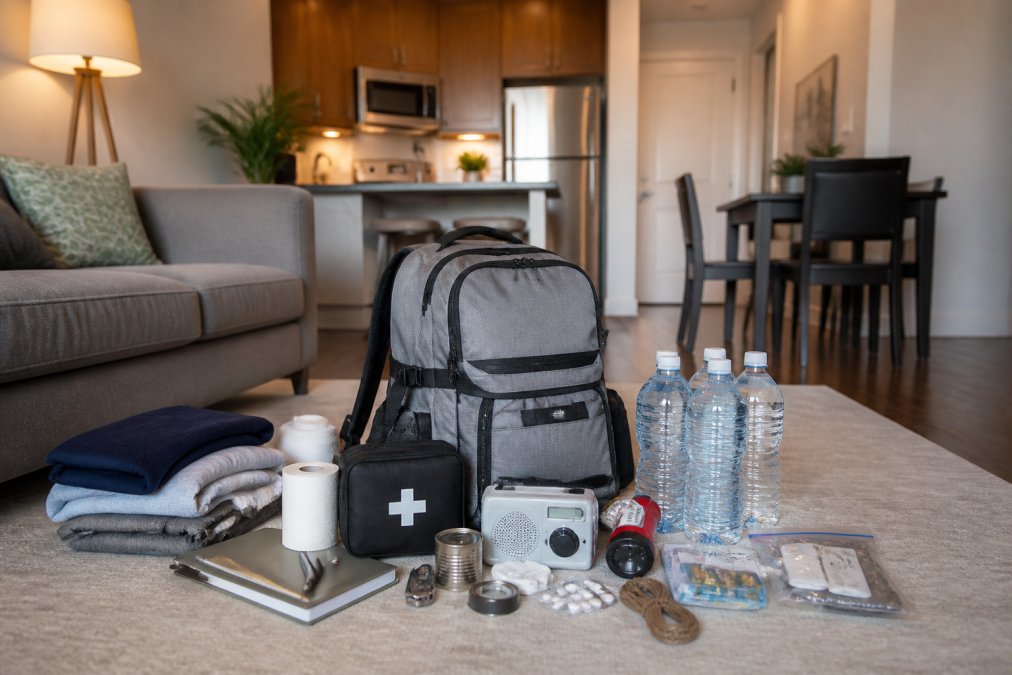
A workable apartment emergency supply checklist covers water, food, first aid, power, sanitation, and documents. The goal isn't a warehouse. It's a compact kit that fits in a closet and stays usable.
Start with the basics the FEMA ready.gov build-a-kit guidance recommends, then trim it to fit apartment realities. The list below adds the quantities and apartment-specific notes most generic checklists leave out.
- Water: one gallon per person per day, minimum three days. Two adults and a pet is roughly 6-7 gallons, which is about 50 pounds of weight. Plan where that weight lives before you buy it.
- Non-perishable food: three days minimum, shelf-stable, no-cook preferred. Canned beans, peanut butter, crackers, and shelf-stable milk cover the basics without needing a heat source.
- Manual can opener. Easy to forget, useless to be without.
- First aid kit with bandages, antiseptic, gauze, tape, gloves, and any personal medications.
- Battery-powered or hand crank radio. A hand crank removes the battery dependency entirely.
- Flashlight and emergency lighting. Headlamps beat handhelds because they leave both hands free on a dark stairwell.
- Whistle for signaling. In a multi-unit building, a whistle carries through walls better than shouting.
- Dust mask and plastic sheeting with duct tape. Useful for smoke or dust intrusion from a neighboring unit.
- Multi-tool and a basic wrench for shutting off a unit-level water valve if you can access it.
- Thermal blanket (one per person).
- Sanitation supplies: moist towelettes, hand sanitizer, trash bags, plastic ties, and a bucket with liners.
- Copies of important documents in a waterproof pouch.
- Printed emergency contact list. Include your building manager's number and your utility provider's outage line.
- Cash in small bills. Card readers and ATMs fail when power does.
Budget-Friendly DIY vs. Pre-made Kits
Building your own kit gives you control over quality and quantity. Pre-made kits save time and remove the guesswork.
Here's the honest trade-off:
| Approach | Best For | Main Drawback |
|---|---|---|
| DIY assembly | Tight budgets, specific dietary needs, renters who already own some gear | Time cost, risk of missing items |
| Pre-made kits | Renters who want it done correctly once | Less control over individual components, often includes filler items you won't use |
| Hybrid | Most suburban apartments | Requires a bit of planning upfront |
A hybrid approach works best for most people: buy a vetted core kit, then add personal items (medications, pet food, foods your family will actually eat) yourself. The pre-made kit handles the boring categories, bandages, paracord, a whistle, so you only think hard about household-specific items.
One apartment-specific note: pre-made kits are often sized for a house and ship in a large plastic tub. Check the dimensions before you buy. A kit that doesn't fit your closet is a kit you won't keep.
How to Store Water in an Apartment Without Losing Floor Space
Water is the hardest item to store in a small apartment because it's heavy and bulky. The solution: move it off the floor entirely.
Store water under beds in flat containers, on the bottom shelf of a closet, and behind furniture. A 5-gallon container fits under most bed frames; stack smaller bottles in a bin that slides under a couch.
For long-term storage, rotate your supply every six months and keep it out of direct sunlight. If you're short on space, water purification tablets and a reliable filter let you store less and treat more when you need it.
Emergency Power Solutions for Renters
Emergency power solutions for renters come down to batteries, not generators. You can't safely run a fuel generator in an apartment, on a balcony, or in an attached garage, so plan around stored power.
The apartment-specific wrinkle: a building-wide outage differs from a neighborhood outage. In a house, you might lose power for a few hours. In a multi-unit building, one electrical fault or flooded mechanical room can knock out elevators, hallway lighting, and water pumps for days, and any building backup systems are usually sized for life-safety systems, not your unit.
What actually works:
- Rechargeable power stations. These store energy and run small devices like phones and a lamp. Capacity is measured in watt-hours (Wh), so match it to what you need to run.
- A hand crank or battery-powered radio. This keeps you connected to emergency broadcasts without draining your main power source.
- Extra battery packs for phones and flashlights.
- Emergency lighting that runs on its own batteries, separate from your phone.
- A small solar panel sized to match your power station, if you have a south-facing window. This is the only way to recharge without grid power.
How to Size a Power Station Without Overbuying
The math is simpler than it looks. A phone charge is roughly 10-15 Wh, a small LED lamp 5-10 Wh per hour, a laptop 50-60 Wh per charge, and a small fan 20-30 Wh per hour.
A 300 Wh power station charges a phone around 20 times, runs a small lamp all night, and still has headroom for a radio. A 1,000 Wh unit runs a small fan overnight and keeps phones topped up for days. Most apartment dwellers don't need more than 500-1,000 Wh unless someone depends on a powered medical device.
The goal isn't to keep everything running, it's to keep communication and light working. Charge your phone and run a lamp. Skip the space heater; it will drain a 1,000 Wh station in under an hour.
What to Power First in a Building-Wide Outage
Priority order matters more than total capacity. In a multi-unit building with no elevator service, plan your power use around these tiers:
- Communication. Phone, radio, and a charged backup battery. This is how you learn what's happening and whether to evacuate.
- Light. A headlamp per person plus one area light. Stairwells may be dark, and you may need both hands free.
- Medical devices. If anyone in the household depends on a powered device, that device jumps to the top of the list and drives your capacity math.
- Comfort. A small fan in summer or a heated blanket briefly in winter. These are optional and should only run after the first three tiers are covered.
Vertical Storage Solutions for Small Spaces
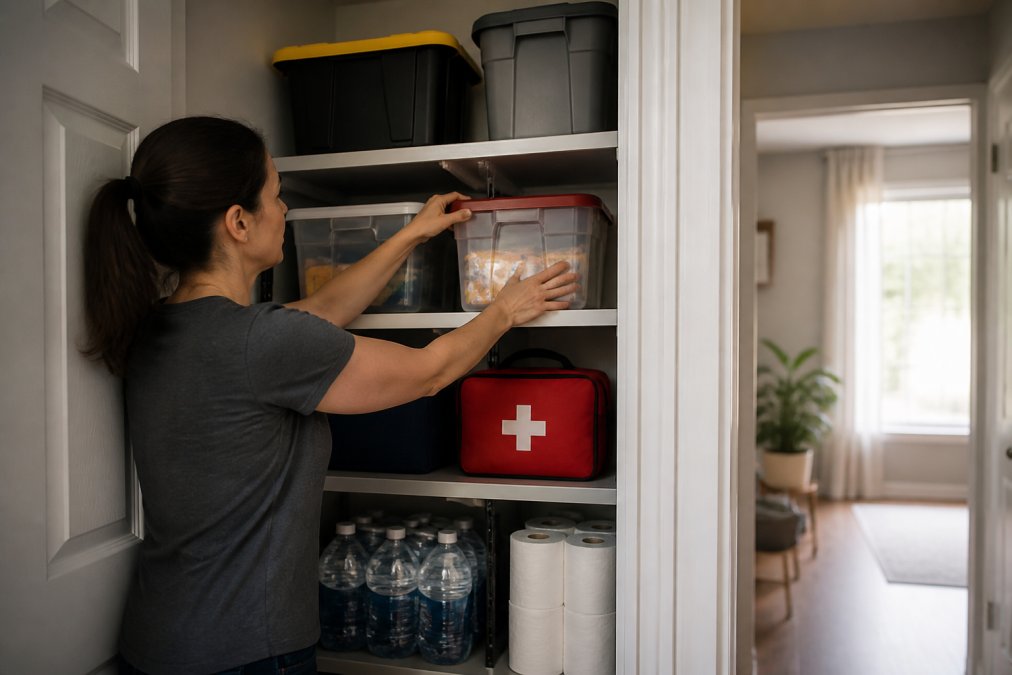
Vertical storage is the biggest space win for apartment dwellers. You're not limited by floor area, but by how well you use the walls.
Practical moves:
- Install adjustable shelving in a closet, floor to ceiling.
- Use stackable bins that lock together so you can build upward.
- Hang a shoe organizer on the back of a door for small items like flashlights, batteries, and first aid supplies.
- Use the space above the fridge and on top of cabinets for lightweight, non-perishable items.
The rule I follow: heavy items go low, light items go high. Water and canned food stay on the bottom shelf. Paper goods, blankets, and documents go up top.
Food, First Aid, and Sanitation Essentials for Apartment Dwellers
Food, first aid, and sanitation are the three categories people under-plan most. Food gets attention; the other two get skipped.
For food, focus on shelf-stable items your family will actually eat. Long-term food storage with a 25-year shelf life removes the rotation headache, which matters in limited space. Emergency rations and freeze-dried meals are compact and lightweight.
For first aid, a stocked kit plus your personal medications is the baseline. Keep a copy of prescriptions and dosages with the kit.
For sanitation, plan for the reality that plumbing may not work. Moist towelettes, hand sanitizer, trash bags, and a bucket with liners cover the basics. Personal hygiene items and any needed supplies for infants or elderly family members belong in this category too.
Medication Management and Important Documents
Medication management means keeping at least a week of any essential prescription on hand, rotated so nothing expires. Store copies of prescriptions, insurance cards, and identification in a waterproof pouch with your kit.
Important documents to protect: birth certificates, Social Security cards, insurance policies, and a printed emergency contact list. Digital copies help, but a printed backup works when the power is out and your phone is dead.
Community-Based Preparedness for Suburban Apartments
Community-based preparedness is the angle most apartment guides ignore, and it's the one that matters most in a building.
You share walls, plumbing, and a power supply with your neighbors. When something fails, it fails for everyone. Knowing who's nearby, who has medical training, and who might need help changes how you respond.
Practical steps:
- Exchange contact information with at least two neighbors.
- Identify anyone with mobility issues, young children, or elderly relatives who may need assistance.
- Agree on a meeting point in case you need to evacuate.
- Share what you have. If one person has a power station and another has a water filter, you're both better off.
Preparedness in a suburban apartment isn't a solo project. It's a small team effort, and the people closest to you are your first responders.
Conclusion
The hardest part of apartment preparedness isn't buying gear. It's accepting that your plan will look different from a homeowner's, and building around that instead of fighting it.
SHTF Prepper Club simplifies this with expert-vetted food, water, power, and safety gear designed for real households, including compact kits that fit apartment storage. Our long-term food storage solutions, water purification tools, and family-oriented guidance take the guesswork out of what to buy and how to store it.
Get started with SHTF Prepper Club and build a kit that actually fits your space, so your household stays ready whether you're sheltering in place or waiting out a multi-day outage.
Frequently Asked Questions
What are the 10 essential items for an apartment emergency kit?
A basic apartment emergency kit should include water (one gallon per person per day for at least three days), non-perishable food, a battery-powered or hand crank radio, flashlight, first aid kit, whistle, dust mask, plastic sheeting and duct tape, moist towelettes and garbage bags for sanitation, and a written emergency contact list. Add medications, a multi-tool, and copies of important documents. Store everything in a go-bag or sealed bin so you can grab it fast if you need to evacuate.
How do you store emergency supplies in a small apartment?
Use vertical space first. Over-the-door organizers, stackable bins, and under-bed storage containers hold supplies without eating floor space. A closet shelf can hold water containers, and a storage ottoman doubles as seating. Keep your go-bag near the entryway. For water, stack cases in a closet or use collapsible containers you fill when a storm is forecast. Rotate food and water every six months so nothing expires before you need it.
How long should an apartment emergency kit last?
Plan for a minimum of 72 hours, but most preparedness guidelines recommend two weeks of supplies for sheltering in place. In a suburban apartment, a power outage or water main break can leave you stranded for days. Aim for 14 days of non-perishable food and one gallon of water per person per day. If space is tight, start with three days and add as you find room. Shelf-stable emergency rations with long shelf lives reduce how often you need to rotate stock.
What specific risks should suburban apartment residents prepare for?
Suburban apartments face power outages, water main breaks, severe storms, and building-wide utility shut-offs. Unlike a house, you may not control your own water heater or breaker panel, so a utility shut-off can affect everyone. Fire is a bigger risk in shared walls, so keep a fire extinguisher and test smoke and carbon monoxide detectors. If you have neighbors who are elderly or have mobility issues, a simple check-in plan helps everyone during an evacuation.